

If you’ve ever tried to plan a field day and stared blankly at a clipboard wondering how to keep 50 kids entertained for six straight hours — you’re in the right place.
Field day games for kids don’t need to be complicated. The best ones are almost stupidly simple to set up. What makes them work is energy, laughter, and that perfect mix of friendly competition and teamwork that gets every child — shy or rowdy, athlete or bookworm — genuinely excited to participate.
Whether you’re organizing a school field day for elementary students, planning kindergarten field day activities, or putting together a family field day in the backyard, this list of 19 Must-Try field day games has you covered. They’re easy to run, adaptable for different ages, and guaranteed to create the kind of memories kids talk about for years.
What Makes a Good Field Day Game?
Not every outdoor game translates to a field day setting. The best field day game ideas share a few things in common:
- Easy to explain in under 60 seconds
- Requires minimal or affordable equipment
- Works for different skill levels and ages
- Keeps multiple kids active at once (no long waiting lines)
- Has a natural element of silliness or surprise
With that in mind, here are all 19 games organized so you can mix and match for a full day of field day stations, relay races, team challenges, and classic outdoor fun.
Classic Relay Race Field Day Games
Relay races are the backbone of any great field day. They’re high-energy, easy to organize, and naturally build teamwork. The outdoor relay game format also means you can run multiple lanes simultaneously — a huge win when you’re managing a crowd and trying to keep wait times short.
1. Classic Sack Race
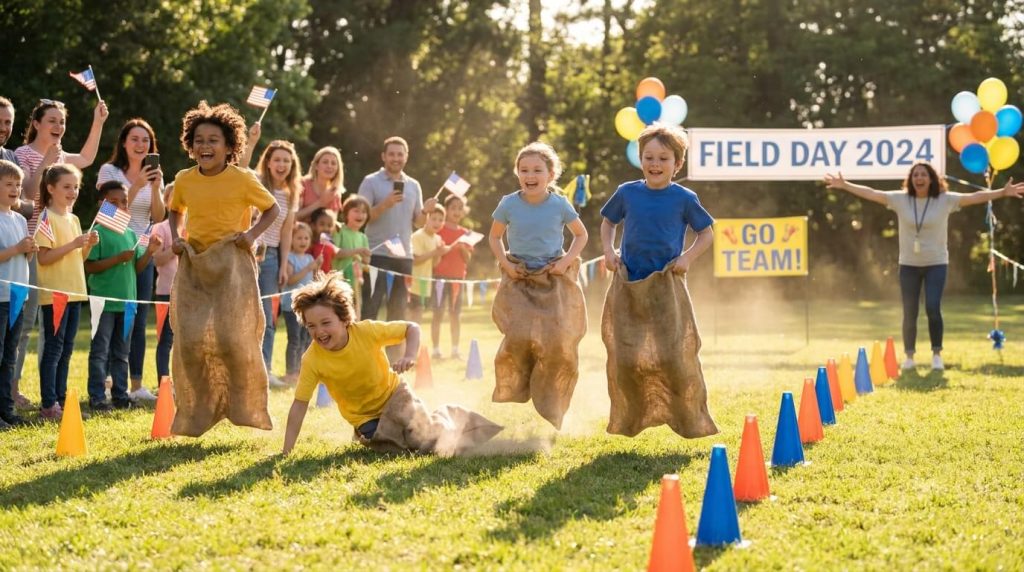
Few things in life are as universally funny as watching kids bounce down a field in a burlap sack. Truly. The sack race is one of those classic field day games that has survived every generation because it’s joyful, low-stakes, and completely unpredictable. The kid who launches out of the gate at full speed and immediately eats grass in the first three seconds is a field day institution.
Each child steps into a large sack or pillowcase and hops from the starting line to the finish. First one across wins — but the real entertainment is the wobbly, bouncing chaos in between.
Fun Twist: Turn it into a relay by having teammates pass the sack at the halfway mark. Add cones as slalom obstacles to hop around, and a 30-second race suddenly becomes a two-minute spectacle. For kindergartners, use smaller sacks so the hops don’t send them flying sideways.
Best for: K–6. Run two or three lanes at once to eliminate wait time and keep everyone active.
2. Three-Legged Race
Pure field day gold. Two players stand side by side, tie their inside legs together with a bandana or soft scarf, and race to the finish. The catch? They have to coordinate every single step — and most pairs discover, immediately and painfully, that they are not naturally synchronized.
This is one of those easy field day games that teaches communication without a single lecture. When a pair finally locks into a rhythm — “left, right, left, right” — and actually executes it, the fist-bumping and screaming that follows is genuinely wholesome. The couples who overthink it? Also great to watch.
Easy Upgrade: Create a three-legged obstacle course where pairs navigate cones, step through hula hoops, and complete a quick challenge before the finish. These outdoor relay games are endlessly replayable because no two runs ever look the same.
Best for: Grades 2–6. Works especially well as a field day station that older students can manage independently.
3. Sponge Relay Race
On a warm day, this might be the field day activity parents and teachers quietly love almost as much as the kids do. It keeps everyone moving and cools them off simultaneously — a rare double win for a hot school fun day.
Each team gets a large bucket of water and a sponge. Players dip the sponge, race down the field, and squeeze as much water as possible into a second empty bucket before tagging the next teammate. The team that fills their bucket to the marked line first wins.
What nobody tells you until you’ve seen it: watching a child sprint at full speed while trying to hug a soaking sponge to their chest is one of the most physically chaotic things that will happen at your event. Add sunshine and you’ve got a field day highlight.
Teacher Tip: Use wide-mouth buckets so the squeeze step is faster and less frustrating. Mark the fill line with tape so the winning condition is perfectly clear — no debates, no “I think we’re close enough.”
Best for: K–6. Hot weather essential. Works beautifully as one of multiple outdoor relay games running at the same time.
4. Balloon Pop Relay
Kids race to a chair, sit on a balloon, pop it — a task that takes way longer than anyone expects — and sprint back to tag the next person. The team that pops all their balloons first wins.
Here’s the thing about balloons: they have no respect for urgency. One kid sits down and theirs pops instantly. The next bounces for a solid 45 seconds before theirs gives up. The crowd screaming “SIT HARDER” is a field day rite of passage that never gets old.
Fun Twist: Before inflating, slip small pieces of paper inside some balloons with silly challenges — ten jumping jacks, your best robot dance, roar like a dinosaur. Not every balloon has one, so the randomness keeps teams guessing and the audience laughing.
Best for: Grades 1–6. Works as both a relay race field day event and a standalone active game for kids of almost any age.
5. Animal Relay Race
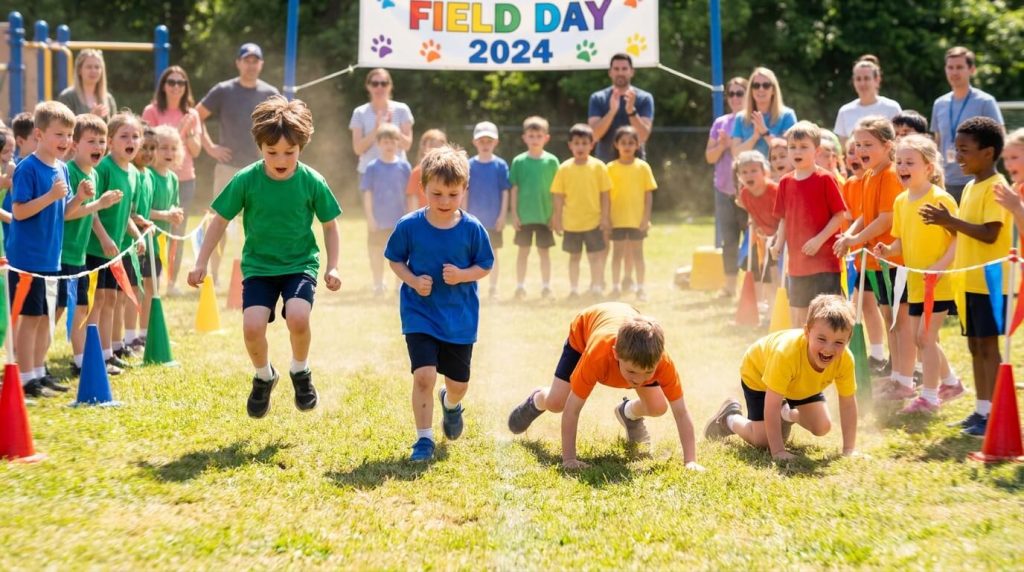
This one is pure magic for younger kids. Instead of running normally, each leg of the relay requires a different animal movement — hopping like a frog, waddling like a penguin, crab-walking, bear-crawling, or slithering like a snake.
If you want to take it further, add the sound requirement. Watching a line of seven-year-olds bear-crawl while growling at full volume is the kind of field day moment that sticks with teachers for years. The kids arrive at the finish line completely out of breath and completely delighted with themselves.
Parent Tip: Save the silliest animals for the longest legs of the course. Nothing finishes a relay quite like a kid crab-walking desperately across a finish line while their teammates scream them home.
Best for: K–3. Requires zero equipment and zero setup time. Perfect for kindergarten field day activities.
Field Day Team Games
These field day team games hit differently from individual events. When the whole team wins or loses together, the emotional stakes go up — in the best possible way. Use these to anchor school spirit moments or build energy around color-war-style field day themes.
6. Tug-of-War Challenge
Few field day team games produce this level of collective investment. Two teams grab opposite ends of a rope and pull. Simple as that. But you’d be amazed how a kid who barely participates in class becomes a motivational coach — screaming strategy, digging their heels in, refusing to let go — during a tug-of-war match.
Run it best-of-three to build drama. Set up a full tournament bracket for even more stakes.
Crowd Favorite: Mark the center line clearly with chalk or a ribbon on the rope. The inch-by-inch drama of watching that ribbon drift toward one side — then suddenly reverse — is genuinely gripping for spectators. If you want to go full chaos mode, position a kiddie pool at the center line. The losing team gets wet. Permission slips recommended.
Best for: Grades 2–6. One of the best active games for kids who need something physical and high-stakes to channel their energy.
7. Giant Parachute Games
If your school has a parachute, it belongs at field day. Full stop. Everyone grabs an edge and the possibilities are nearly endless — every single one of them produces collective joy that’s hard to replicate with any other playground activity.
The classics: shake it rapidly to send foam balls flying, play “Mushroom Tent” where everyone raises it high and ducks underneath before it collapses, or run “Color Call” where specific kids let go, run under, and grab a new spot before the fabric comes down.
The all-time crowd favorite is “Shark Attack.” One kid crawls under the parachute as the shark, using the fabric as camouflage, while slowly and dramatically pulling teammates under one by one. The screaming when someone feels a tug on their ankle is something you have to experience.
Best for: K–5. One of the best cooperative school fun day activities for groups of 15–30 kids.
8. Blindfolded Maze Walk
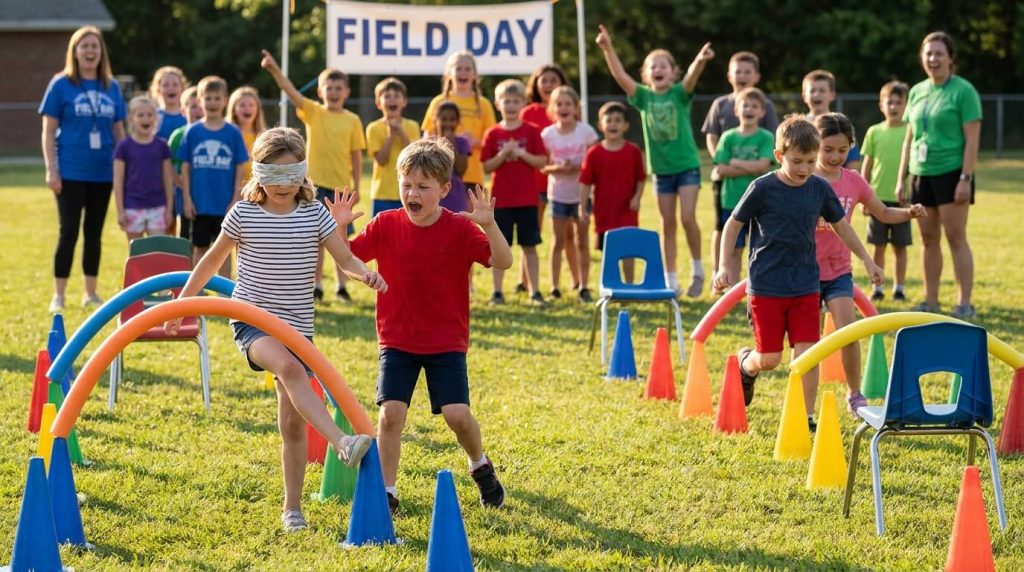
This game quietly teaches more life skills than almost any other on this list. One child is blindfolded and must navigate a maze of cones, chairs, or pool noodles using only verbal directions from a partner on the sideline. No touching. No peeking. Just communication.
What makes it memorable: the guided kid who nods confidently, says “I got it,” and immediately walks directly into a cone. Or the partner who can give perfect directions until competitive pressure kicks in and they suddenly forget their left from their right.
When a pair completes it cleanly and quickly, the relief and celebration feel genuinely earned.
Easy Upgrade: Run two teams simultaneously to make it a race. The pressure of competition makes the communication challenge dramatically harder — and far more entertaining to watch.
Best for: Grades 3–6. One of those field day team games that works equally well as a PE game or social-emotional activity.
Water Field Day Games
These are the field day activities kids request by name every single year. Run at least two or three of these on a warm day — they’re your best tool for keeping energy levels high while making sure everyone stays cool and smiling.
9. Water Balloon Toss
Classic. Timeless. Still works every single time. Kids pair up, start close together, and toss a water balloon back and forth. After each successful catch, both players take one step backward. Last pair with an unpopped balloon wins.
The tension builds quietly and suddenly — most games feel relaxed until pairs realize they’re now standing 15 feet apart and the balloon is starting to stretch from hard throws. When one finally explodes, the reaction is always the same: a half-second of stunned silence, then absolute chaos.
Fun Twist: For older students, introduce a one-hand catch rule or require the catcher to be standing on one foot. For large groups, run a tournament bracket — winning pairs advance until a champion pair emerges. This format works great as an end-of-day backyard games for kids showdown too.
Best for: K–6. One of the most popular outdoor games for kids on any warm field day.
10. Ice Cube Melt Race
This one surprises people every time. It sounds like a throwaway activity and turns into one of the most intensely focused moments of the day.
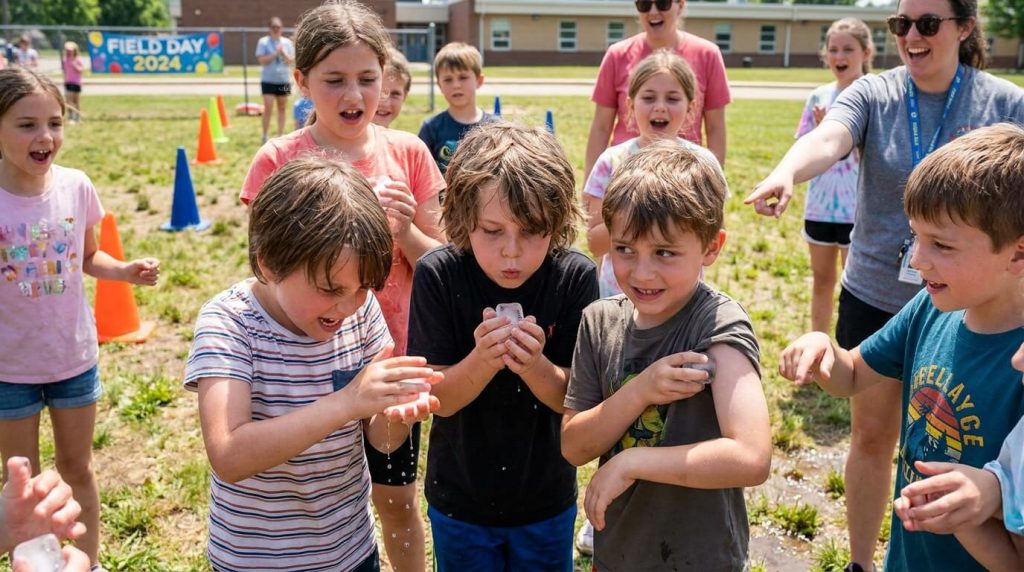
Give each child one ice cube. Goal: melt it completely using only their hands. Rubbing, blowing, pressing between palms — whatever works. No smashing. No tools. Just willpower.
What you’ll actually see: kids who start laughing at how easy it sounds, then get genuinely competitive about two minutes in. Some rub furiously. Others press the cube between their palms and breathe on it methodically, eyes narrowed like tiny scientists. A few try tucking it into their armpit. (It works, actually, which creates a whole new energy when other kids notice.)
Easy Upgrade: Run it as a team relay — each player holds the ice cube for 20 seconds before passing it to the next teammate. First team with a fully melted cube wins. For younger kids, use smaller cubes or extra time. For older students, use larger cubes as a pure endurance test.
Why Kids Love It: It requires zero athletic ability and rewards strategy over speed. The kid who can’t run fast can absolutely win the ice cube melt race — and sometimes does, triumphantly, which is one of those field day moments worth planning for.
Best for: K–6. Perfect as a between-events breather at field day stations. Costs virtually nothing.
Balance and Precision Field Day Games
Not every field day activity should be a sprint. These games reward steadiness and focus — and often produce the funniest unscripted moments of the entire event.
11. Spoon and Egg Race
Looks easy. Is not easy. Each player balances an egg — plastic or hard-boiled, your call, though plastic is the smarter teacher choice — on a spoon and races to the finish. Drop it, go back to start.
The walk of shame back to the starting line after a drop — especially when the egg rolls dramatically in the wrong direction first — is somehow funnier every single time it happens. Kids still in the race watch it with a mix of sympathy and barely concealed relief.
Quick Tip: For a harder challenge, have players hold the spoon in their mouths instead of their hands. Add cones to weave through, or build a full obstacle course they must navigate while balancing. Both variations work well as PE games or as part of a longer obstacle course field day setup.
Best for: K–6. A great standalone classic field day game or a warmup event before longer relays.
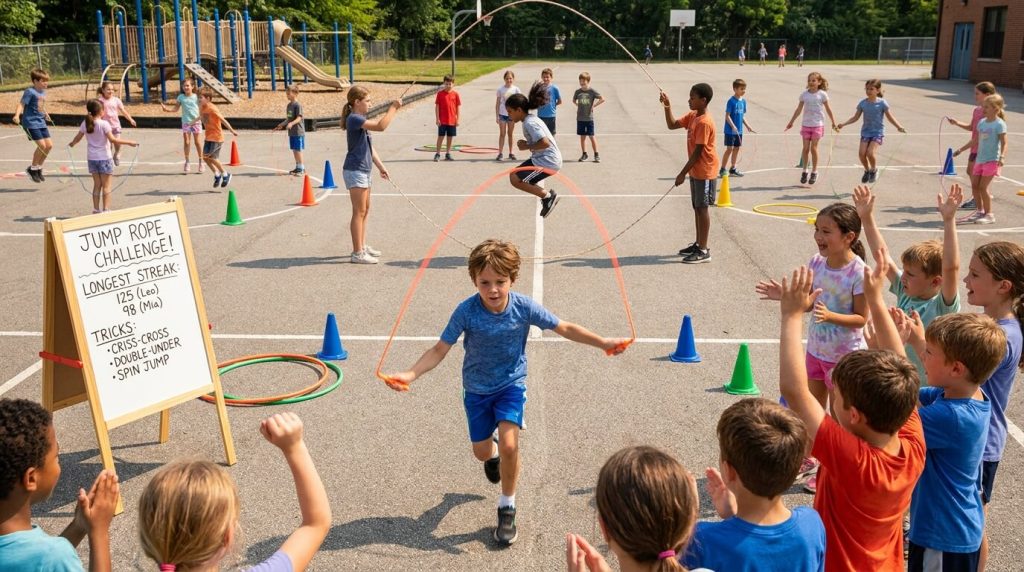
12. Jump Rope Contest
This game has more range than it gets credit for. At the basic level it’s simple: how many jumps can you do without stopping? That question alone is enough to make a kid jump for four solid minutes without noticing.
But it has real depth for older elementary students. Double Dutch — two ropes turning simultaneously while one jumper works the middle — is a legitimate skill that kids who’ve practiced it are proud of, and rightfully so. Running it as a station where those kids get to show off gives them a genuine spotlight moment.
Set up a “trick challenge” whiteboard at the station: criss-cross arms mid-jump, spin 180 degrees while jumping, try a double-under (rope passes twice in one jump). You don’t have to announce it — just post the list and watch kids try to check off as many tricks as they can between turns.
Fun Twist: Run a “longest streak” leaderboard throughout the day. Kids will come back between rotations specifically to beat their score. It turns a single station into an ongoing competition thread that runs all day without any extra effort from you.
Teacher Tip: Keep two or three ropes active at this station at all times. Single-rope contests with one player at a time creates the kind of wait line that loses kids’ attention fast.
Best for: Grades 2–6. Double Dutch works especially well for grades 4–6.
13. Ring the Cone Toss
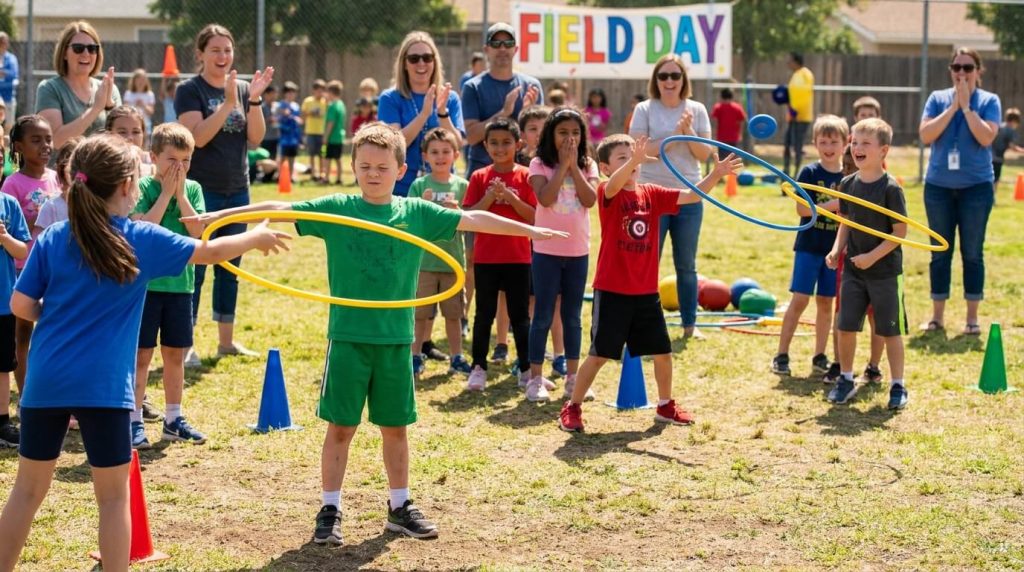
Set up cones at varying distances. Give each player a handful of rings — actual ring toss rings, embroidery hoops, or hula hoops for a jumbo backyard-games-for-kids version. Score points by landing rings on targets, with farther cones worth more.
This runs especially well as a self-managed field day station because the scoring system is intuitive, kids can moderate it themselves, and it doesn’t require a dedicated adult to referee.
Easy Upgrade: Add a team relay format — each player must land one ring before the next teammate can go. First team to have all members score wins. Toss in a “bank shot” bonus target (land a hoop off one cone and onto another) for extra points to keep older students engaged and strategizing.
Best for: K–6. Low cost, low setup, endlessly repeatable. One of the best school carnival games when you need stations that practically run themselves.
14. Human Ring Toss
Take the classic concept and flip it. One teammate stands a few feet away with arms raised, acting as the target. Their partner tries to land a hula hoop around them. The target can move slightly — swaying, reaching, stepping in place — but can’t leave their spot.
What makes this game: the targets. Some kids stand perfectly still and focused, like they’re defusing a bomb. Others flail dramatically at every incoming hoop, trying to will it onto their arms. Both styles are equally entertaining.
Fun Twist: Award more points for successful tosses from greater distances. Give the target a constraint — standing on one leg, doing a full spin before catching — to keep things interesting across multiple rounds.
Best for: Grades 2–6. Works well as a rotating field day station or a competitive team event.
Silly and Creative Field Day Activities
Every great field day needs games whose sole purpose is to make everyone — participants and spectators both — completely lose it. These deliver every time.
15. Dizzy Bat Race
Place your forehead on the top of a bat or pool noodle, spin in place five to ten times, and then try to run to the finish line. That’s it. That’s the whole game.
Describing it doesn’t do it justice. What actually happens is: some kids stumble sideways in a perfect 90-degree angle from the intended direction. Some make it about three feet before sitting down because the world is moving too fast. A few somehow run almost perfectly fine, which is somehow the most unsettling outcome of all.
The spectating during a dizzy bat race is genuinely better than most things on television.
Fun Twist: Run it as a relay — each participant spins, staggers to a teammate, and tags them before collapsing. Add a cone they’re “supposed to” run around post-spin. That phrase does a lot of work in this context.
Best for: Grades 3–6. Needs a wide, open, flat area. One of the highest entertainment-value easy field day games on this entire list.
16. Freeze Dance
Between high-intensity games, freeze dance is your reset button. Kids dance freely to music; the moment it stops, everyone freezes. Move after the cut, and you’re out.
It sounds too simple to work well with older kids. It is not too simple. Once you add surprise rules — “you must have at least one hand on the ground when the music stops,” “you must strike a superhero pose,” “you must be holding onto someone else’s shoulder” — even fifth-graders get competitive about it.
The kids who get eliminated watch the remaining players with the intensity of a playoff game.
Why Kids Love It: It’s active, musical, and unpredictable in exactly the right way. Works equally well for kindergarten field day activities and third-graders who would normally roll their eyes at the words “dance game.”
Best for: K–4. Perfect as an energy transition between physically demanding outdoor games for kids. All you need is a Bluetooth speaker.
17. Shoe Scramble
Zero equipment. Zero setup. Maximum chaos.
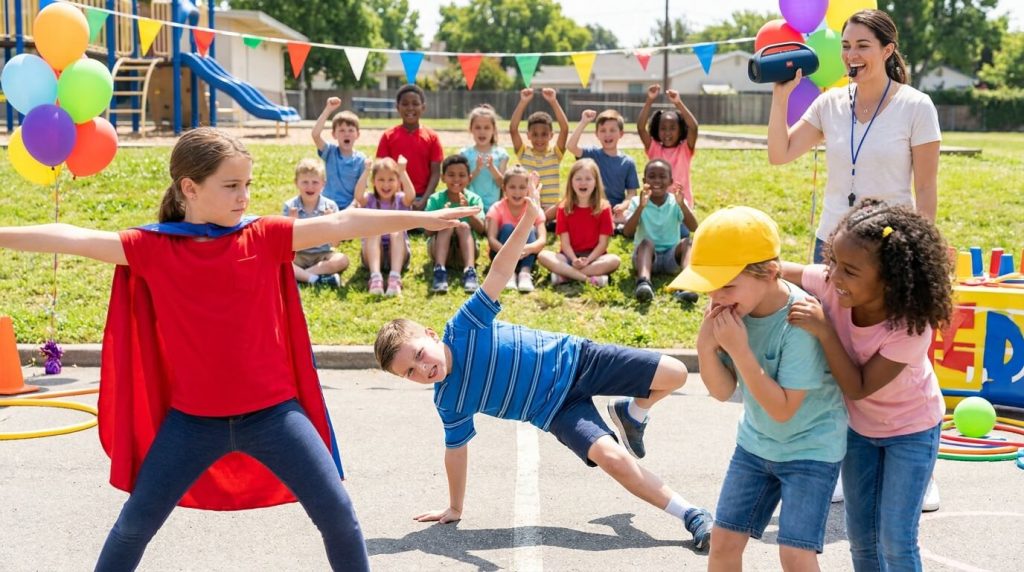
Every participant removes both shoes and throws them into one giant pile in the center of the field. On “go,” everyone races to find their shoes, put them on correctly, and run back to a finish line. First one back wins.
The pile looks innocent until 30 kids descend on it simultaneously. Then it becomes a blur of shoelaces, misidentified sneakers, someone’s sock flying through the air, and one kid confidently putting on a shoe three sizes too large before realizing the mistake at full sprint.
Easy Upgrade: Require shoes to be fully tied before crossing the finish line. Or add a rule that players must hop on one foot while searching. Either variation makes an already funny game somehow funnier.
Best for: K–6. One of the best free field day game ideas — it literally costs nothing and delivers four solid minutes of pure entertainment every time.
18. Hula Hoop Challenge
Two versions, both worth running. The individual endurance contest — who can keep the hoop going longest — is self-organizing from the moment you hand out the hoops. Kids will start competing before you even explain the rules.
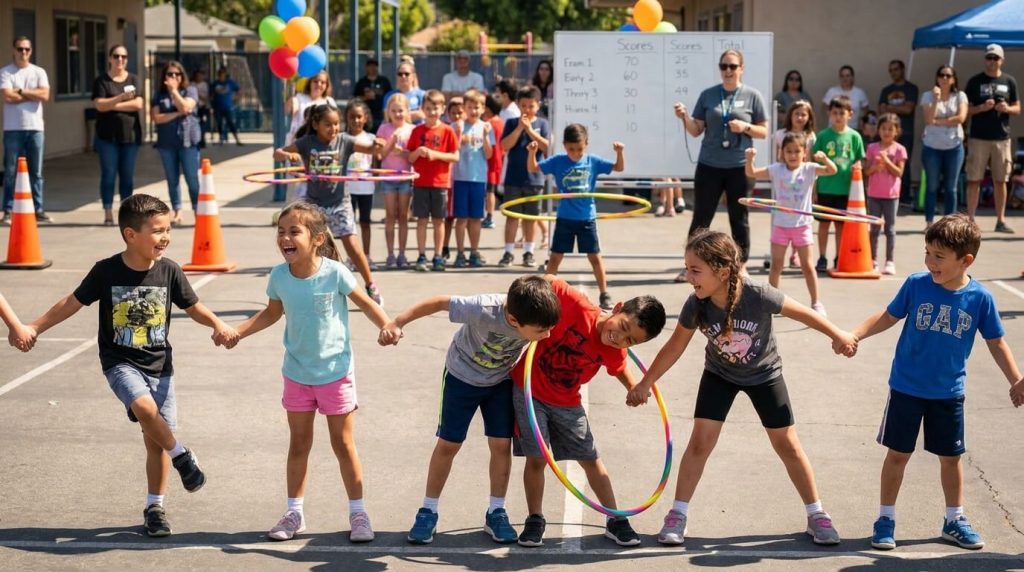
But the Hula Hoop Pass is where this game truly lives. Players stand in a line holding hands. A hula hoop hangs on one end. The group must pass it all the way down the line — over heads, through legs, around bodies — without releasing hands. The wiggling and contorting and near-falls as each person maneuvers the hoop past their shoulders while maintaining hand contact is genuinely spectacular to watch.
Teacher Tip: Time each team and post results on a whiteboard. The improvement from a team’s first attempt to their second — once they’ve figured out a strategy — is dramatic and motivating.
Best for: K–6. Great for field day team games and cooperative school fun day activities.
Quick-Setup Field Day Stations
When you’re managing a full event, you need a few stations that practically run themselves. These work with minimal supervision and hold up through multiple rotations without losing steam.
19. Freeze Tag Relay
Classic freeze tag, with a relay twist. One team sends a tagger; the other team tries to cross the field without being frozen. Tagged players freeze in place and can only be unfrozen when a teammate crawls through their legs. Teams swap roles after a set time, and the team with the most successful crossings wins.
It’s one of those playground activities kids already know the rules to — which means zero explanation time and immediate, full-engagement chaos.
Why Kids Love It: The “unfreeze” mechanic creates genuine teamwork moments. The kid who risks being tagged to free a frozen teammate becomes a hero. The tagger who freezes three people in ten seconds becomes a minor field day legend. You get both stories from a single 10-minute rotation.
Best for: K–6. Ideal as a high-energy day opener or a finale game when you want everyone exhausted and happy.
Still have energy to burn after field day? These fun summer activities for kids keep the outdoor excitement going all season long.
How to Actually Plan a Field Day That Runs Smoothly
Good field day event ideas are only half the job. Here’s what separates a smooth, memorable event from a chaotic one.
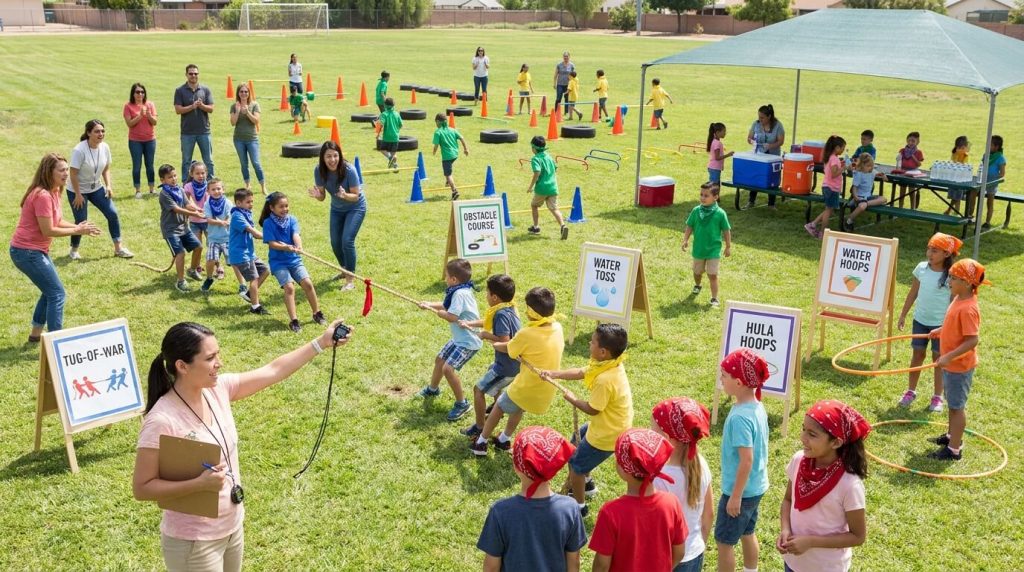
Run stations, not a single sequence. Set up 8–12 field day stations and rotate groups through on a timer. Every kid stays active simultaneously, there are no long wait lines, and you can manage the whole event with fewer adults. A timer app on your phone or a simple bell system works perfectly for rotations.
Rotate every 8–12 minutes. Less than 8 and kids don’t fully settle into the game. More than 12 and energy starts to dip. For kindergarten field day activities, 6–8 minutes per station is usually enough. Adjust based on how engaged your groups look during the first rotation.
Balance the energy demands. Don’t put three high-intensity relay races back to back in the rotation order. Alternate heavy-energy games (tug-of-war, obstacle course) with lighter ones (ring toss, freeze dance, ice cube melt race). This keeps kids engaged all day instead of burning out in the first hour.
Post instructions at every station. A laminated card with a simple diagram means kids can get started without waiting for an adult explanation. This is the single biggest time-saver at any multi-station field day. It also lets parent volunteers manage stations without needing a briefing.
Build in a water and shade break. For outdoor games on warm days, plan an explicit 10-minute break mid-event. Kids rarely ask for breaks themselves — they’ll run until they drop. A scheduled pause with water and shaded seating keeps the afternoon energy from collapsing entirely.
Plan for weather in both directions. Hot day? Weight your stations toward water field day games — sponge relays, water balloon toss, ice cube melt race. Cooler day? Lean into high-movement relay races and tug-of-war that generate body heat. Keep a short indoor backup list for unexpected rain: freeze dance, seated balloon pop challenges, and hula hoop contests all adapt indoors with minimal fuss.
Use color-coded teams. Assigning teams by color before the event — and giving each kid a colored bandana or pinnie to wear — eliminates the “which team am I on?” confusion that eats five minutes at every station transition. It also makes tournament brackets, tug-of-war matchups, and team relays dramatically easier to manage on the fly.
Frequently Asked Questions About Field Day
What are the best field day games for elementary students?
Relay races (sack race, sponge relay, three-legged race), team challenges (tug-of-war, parachute games), and water activities (water balloon toss, ice cube race) consistently get the most energy and enthusiasm from elementary students. The key is mixing competitive games with cooperative ones so every personality type gets a moment to shine.
What are good field day games for kindergarten?
For kindergarten field day activities, keep rules simple and distances short. Animal relay race, freeze dance, hula hoop challenge, shoe scramble, sponge relay, and freeze tag relay all work beautifully. Avoid games requiring precise throwing or complex strategy — the goal at this age is joyful movement, not scorekeeping.
How long should a field day last?
For most elementary schools, 2.5 to 4 hours is the sweet spot. Long enough to run 8–12 stations with proper rotations and a break, short enough that energy stays high throughout. Half-day formats tend to work better than full-day events for younger students. Kindergarten and first-grade groups typically do best with a 90-minute to 2-hour event — any longer and you’re managing fatigue instead of fun.
How many stations should a field day have?
For a 3-hour event with groups of 20–30 kids, plan 8–10 stations. This gives each group roughly 15–18 minutes per station after factoring in transition time. Smaller events with fewer kids can run 6–8 stations comfortably. The goal is that every station is always full — no group ever standing around waiting for something to happen.
How do you organize field day teams?
The simplest method: pre-assign kids to color-coded teams before the event. Give each team a colored bandana or pinnie they wear all day. For school-wide events, keep class groups together but assign each class a team color so larger competition brackets work smoothly. Pre-assigning avoids the drama of self-selection and the chaos of last-minute regrouping.
What are cheap field day games?
Almost everything on this list. Shoe scramble, freeze tag relay, and animal relay race are completely free. Sponge relay, freeze dance, three-legged race, and freeze dance each cost under $5 in supplies. The most expensive items here are hula hoops ($2–5 each) and a parachute ($40–80, but a good one lasts for years). Most schools and community centers already own everything needed.
What field day games work best for mixed age groups?
Water balloon toss, obstacle course madness, freeze tag relay, shoe scramble, and hula hoop challenge all scale naturally across ages. For mixed-age events, pair older kids with younger ones as buddies — it keeps younger students engaged and gives older students a leadership role they often genuinely enjoy. For tug-of-war with mixed ages, balance teams by weight rather than grade.
How do you avoid long wait lines at field day stations?
Three strategies: (1) run parallel lanes for any relay game so multiple kids race simultaneously, (2) keep rotation groups small — 5–8 kids per station works best, and (3) choose games where spectating is genuinely fun so waiting feels like watching rather than standing around. Dizzy bat races and jump rope trick contests work especially well here — the crowd stays entertained between turns, which means even the kids waiting are engaged.
Final Thoughts
Field day is one of those school events kids genuinely look forward to — and when it’s well-planned, it lives up to the hype every time. These 19 games have been chosen because they’re fun, inclusive, and flexible enough to work across a wide range of settings, from large school field day events to small family field day activities in the backyard.
The most important thing isn’t any single game. It’s making sure every kid — regardless of how athletic or competitive they are — gets to laugh, move, and feel like part of something. The kid who can’t run fast can win the ice cube melt race. The shy kid might turn out to be an incredible guide in the blindfolded maze walk. The chaos of the shoe scramble is an equalizer for everyone.
Plan the stations. Color-code the teams. Fill the water balloons. Then get out of the way and let the day take care of itself.
It will.