Children thrive when they play together. Play is not just entertainment; it’s a powerful teacher. Every laugh, every challenge, and every small victory during a game becomes a life lesson in patience, empathy, problem-solving, and teamwork. When kids collaborate, they learn to listen closely, negotiate differences, encourage one another, and celebrate group wins.
But here’s the challenge: finding games that truly build these skills indoors can feel tricky, especially when space is limited. Not every classroom or living room has the luxury of wide open space or fancy equipment. That doesn’t mean teamwork has to wait until recess.
The good news? With a little imagination and a few everyday supplies, any indoor space can transform into a playground for collaboration and bonding. These activities are not about who’s the fastest or strongest, but about showing children that success feels richer when achieved together.
Whether you’re a teacher looking for quick energizers, a youth leader planning group sessions, or a parent stuck indoors on a rainy day, this list of 25 indoor team-building games blends laughter, creativity, and cooperation. Best of all, they’re flexible enough for small spaces, easy to set up, and big on life lessons.
Why Indoor Team-Building Games Matter
When kids play together, they’re doing more than just passing time — they’re practicing life skills. Team-building activities help children develop patience, empathy, problem-solving abilities, and communication skills in a way that feels fun and effortless. Even in small spaces, games that encourage collaboration remind kids that everyone’s contribution counts and that working as a group can be even more rewarding than winning alone.
How to Create a Team-Building Environment Indoors
You don’t need a gymnasium or playground to spark teamwork. A classroom, living room, or community center can quickly transform into a teamwork workshop with just a few simple supplies like balloons, yarn, or paper. The key is setting the right tone: emphasize cooperation over competition, kindness over speed, and fun over pressure. When kids feel safe and supported, they’re more willing to take risks, share ideas, and cheer for each other.
1. Balloon Bridge Builders
Give each team balloons and tape, and challenge them to build a “bridge” strong enough to hold a lightweight object like a toy car.
At first, kids may rush to inflate as many balloons as possible, only to hear them pop. Soon, they realize that patience, steady hands, and careful planning matter more than speed. This game sparks engineering curiosity while reinforcing the value of teamwork.
Tip: Remind kids to assign roles — one inflates, one tapes, one positions. Everyone’s effort contributes to the success.
2. Word Circle
Hand out word cards with random nouns, verbs, or adjectives. The team must arrange themselves in a circle to form a logical sentence or story.
Children learn that creativity blossoms when they listen to each other’s ideas. It’s less about “my card” and more about how “our cards” fit together.
Variation: Use themed words (e.g., animals, food, space) to add fun twists.
3. Marshmallow Builders
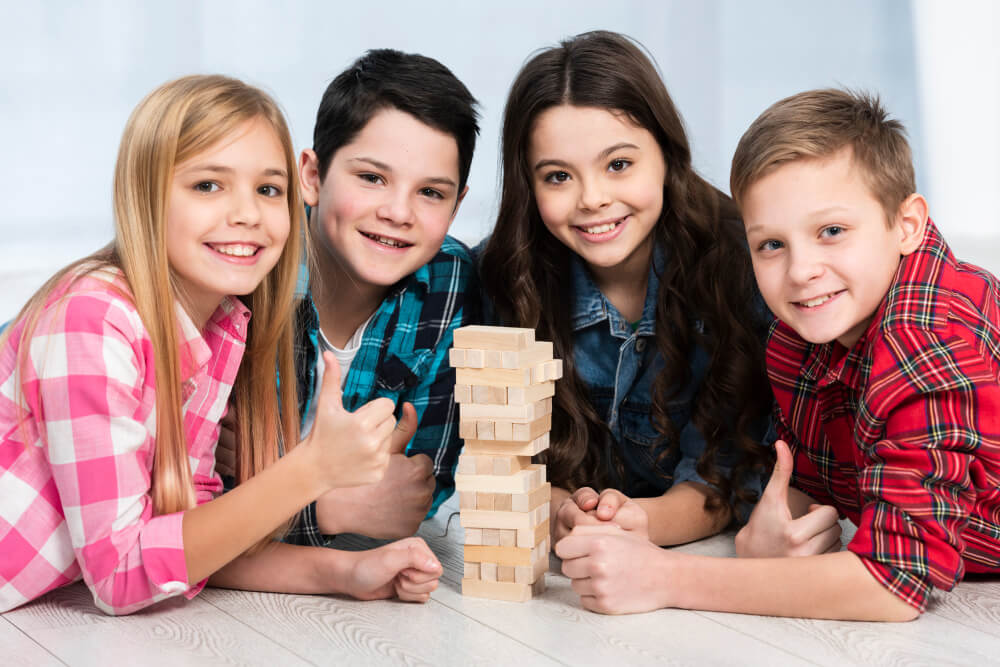
Armed with spaghetti sticks and marshmallows, teams must construct the tallest free-standing tower possible in 10 minutes.
It’s sticky, silly, and surprisingly strategic. Kids experiment with bases, balance, and teamwork. Someone might try to build tall too quickly, only for the tower to topple — a perfect moment to teach patience and planning.
Lesson learned: Collaboration works best when each member takes a different responsibility.
4. Chain Reaction
Using dominoes, blocks, or recyclables, teams design a working chain reaction that must run smoothly from start to finish.
Children quickly notice that every tiny piece matters. If one section is poorly placed, the whole sequence fails. This becomes a living metaphor for teamwork: everyone’s role is important.
Encourage: Celebrate partial success and let kids troubleshoot together until the reaction runs fully.
5. Circle of Compliments
Kids sit in a circle and pass a soft ball. Whoever catches it receives a compliment from the thrower.
This activity strengthens trust and kindness. Children light up when recognized for something as simple as “You always share your crayons” or “You’re a good friend.”
Why it works: Team building isn’t only about problem-solving; it’s also about nurturing positive relationships.
6. Group Sculpture
Provide playdough or clay and challenge teams to sculpt something that represents teamwork.
The beauty lies in how children interpret the theme. One group might build a boat, another a chain, and another a circle of hands. The discussion around their creations is just as valuable as the sculpture itself.
Tip: Ask kids to explain their sculpture to the group — this helps build communication skills.
7. Sentence Relay
One child begins a story with a single sentence. Each teammate adds a new sentence, continuing until a full story emerges.
This teaches listening, as kids must follow the thread instead of steering the story in random directions. The end result is usually funny, surprising, and delightfully creative.
Variation: Add a time limit of five seconds per response to keep the energy high.
8. Color Hunt Teams
Pick a color and ask teams to find items of that color in the room. The catch: no duplicates allowed.
This small twist forces children to communicate. They must negotiate who will bring which item so that their team succeeds.
Bonus: For older kids, challenge them to find items in a gradient of shades from lightest to darkest.

9. Blanket Transport
Place an object like a soft ball on a blanket. Teams must carry it across the room without letting it roll off.
The trick? They need to move together, at the same pace, with constant communication. If one person pulls too quickly, the ball tumbles.
Lesson learned: Teamwork is about adjusting to others, not just charging ahead.
10. Guess Who’s Talking
One child is blindfolded while teammates take turns saying a silly phrase. The blindfolded player must guess who spoke.
This builds sharper listening skills and helps children recognize the uniqueness of each teammate’s voice. Giggles are guaranteed when voices are disguised.
11. Human Conveyor Belt
Children lie side-by-side on the floor and use only their feet to pass a lightweight object down the line.
The game requires rhythm, patience, and trust. If one person loses focus, the “belt” breaks — reminding everyone that success depends on collective effort.
12. Sock Sculptures
Give teams a pile of rolled-up socks. Their challenge: create animals, towers, or letters.
It’s soft, safe, and surprisingly creative. Kids learn that even ordinary objects can spark teamwork and imagination.
Variation: Host a “Sock Museum” where each group explains their creation.
13. The Shape Shuffle
Assign each team a shape — triangle, circle, square. They must arrange themselves into that shape without speaking.
This silent challenge pushes children to pay attention to gestures, eye contact, and body positioning. Non-verbal communication is just as important as spoken words.
14. Cooperative Drawing
Two children share a pen — each holding one end — and must draw a specific object together.
The result is often lopsided, funny, and unexpectedly creative. More importantly, it shows that working in sync requires compromise.
Tip: Rotate partners so every child gets to experience different dynamics.
15. Balloon Pass
Line up the team. They must pass a balloon down the line using only elbows, knees, or heads — no hands allowed.
The silliness makes everyone laugh, but real success requires patience and steady coordination.
16. Secret Builders
Divide the group into two teams. Each team receives half of a mystery picture (like one side of a house). Without showing each other, they must describe their half and recreate the full image together.
This game shines a spotlight on communication skills — being clear, listening well, and checking for understanding.
17. Silent Skits
Teams create a short skit but must act it out without speaking. Gestures, expressions, and creativity take center stage.
The performance often turns hilarious, but beneath the fun, children learn how powerful non-verbal teamwork can be.
18. Magazine Collage Teams
Provide scissors, glue, and old magazines. Teams cut and paste images to create a collage based on values like “friendship” or “dreams.”
It’s creative, hands-on, and deeply meaningful when kids discuss why they chose certain images.
19. The Web of Goals
Using yarn, children toss the ball across the circle while sharing personal goals. Each throw connects the web, symbolizing how everyone’s dreams are linked.
Lesson: Individual hopes are stronger when supported by a community.
20. Balance Beam Partners
Tape a line on the floor. Pairs must walk the line hand-in-hand without stepping off.
If one struggles, the other provides balance and encouragement. This builds patience and empathy in a very tangible way.
21. The Listening Game
One child gives a series of instructions (“clap twice, jump, spin”), and the group must follow together.
When kids follow carefully, the result is a well-coordinated routine. When they don’t listen, chaos ensues — a memorable reminder of why listening matters.
22. Build-a-Story Cards
Provide cards with pictures of objects or characters. Teams must build a story that uses every card.
This fosters compromise as children debate how to include all elements. The stories are often hilarious, but they also showcase teamwork in narrative form.
23. Mystery Bag Challenge
Fill a bag with random household items. Teams draw a few and must invent a new product, skit, or story featuring them.
Kids giggle while brainstorming wild ideas, but at the heart of it, they’re practicing cooperation and creative thinking.
24. Cooperative Freeze Frame
Give teams a theme — circus, castle, zoo. They must pose together in a frozen tableau.
The results are funny and imaginative, but they also highlight unity and group creativity.
25. Kindness Chain
Hand out strips of paper. Each child writes one act of kindness, then links the strips into a chain.
As the chain grows, so does the message: kindness multiplies when practiced together.
FAQs About Indoor Team-Building Games for Kids
Q1: How do these games benefit children beyond fun?
They nurture social-emotional skills such as empathy, cooperation, patience, and resilience. Many also spark creativity, problem-solving, and leadership. These lessons carry into classrooms, friendships, and everyday life.
Q2: Do these games require a large space?
Not at all. Most of these activities are designed for small areas like classrooms, living rooms, or community centers. The emphasis is on teamwork, not running or jumping.
Q3: Are these suitable for all ages?
Yes, though you can adjust complexity. For younger kids (ages 5–7), keep instructions simple and use larger props. For older kids (ages 10–12), add time limits, roles, or small competitions for extra challenge.
Q4: What supplies should I keep handy?
A small kit with balloons, tape, paper, markers, yarn, magazines, and soft balls is enough. Most activities use everyday items you already have at home or school.
Q5: How long should a session last?
Each game takes about 5–15 minutes. For a full team-building session, combine 4–6 activities with a mix of quiet, reflective games and active, high-energy ones.
Final Thoughts
Indoor team-building games remind children that joy grows when shared. Whether they’re balancing balloons, building marshmallow towers, or linking kindness chains, the laughter echoes long after the activity ends. More importantly, they take away life lessons about listening, compromise, and celebrating one another’s strengths.
You don’t need a gym or playground to teach collaboration. All you need is creativity, cooperation, and the willingness to play. So next rainy day, classroom break, or family night, pull out one of these games. Watch how quickly children discover the magic of teamwork — and how much brighter the room feels when everyone is working, laughing, and learning together.