

Moving into a new home is one of life’s most exciting milestones. Whether you’re settling into your first apartment, upgrading to a bigger space, or starting over somewhere new, a housewarming party is how you mark the moment — and make it real.
But a great party isn’t just about good food and drinks. It’s about connection. And that’s exactly where housewarming party games come in. The right games break the ice between guests who don’t know each other, spark conversations that wouldn’t happen otherwise, and turn a standard get-together into something people remember for years.
If you’re hosting a smaller, more intimate group, you’re already in a good position. Small gatherings create a warm, cozy atmosphere where people actually talk to each other — and the 18 housewarming games and activities below are designed specifically with that in mind. For every game, you’ll find not just how to play it, but who it works best for, how much time and setup it takes, and exactly when during the party to bring it out.
Why Housewarming Party Games Make the Difference
Not everyone at a housewarming party knows each other. You might have college friends, coworkers, neighbors, and family all in the same room for the first time. Without some structure, conversations stay surface-level, groups cluster with the people they already know, and the energy never quite gets off the ground.
Games fix that naturally. They give people something to do together, create shared experiences on the spot, and get everyone laughing without anyone feeling singled out. The best housewarming party activities are easy to explain, quick to join mid-round, and require no special skill — just a willingness to show up and have fun.
The 18 ideas below range from zero-prep conversation starters you can run in five minutes to hands-on creative challenges that anchor a full hour of the party. Mix and match based on your group size, your home’s layout, and how much energy you want to put into planning.
How to Use This Guide
Every game below is organized so you can make a decision fast. After the main description of how the game works, you’ll find three sub-sections that cover the practical details hosts actually need to know before choosing an activity:
Who It Works Best For — recommended group size, age suitability, and which types of guests get the most out of it.
How Much Time and Setup You’ll Need — realistic time estimates, materials list, and prep effort so you’re never caught off guard.
When to Play It and Where It Fits — the ideal moment in the party to bring the game out, plus whether it works better in small apartments or larger homes, indoors or outdoors.
Scan those sections first if you’re short on time. Read the full description when you want to understand the game’s texture — why it works, what makes it funny or meaningful, and how to run it well.
18 Fun Housewarming Party Games and Activities
1. Home Trivia Challenge
This is one of the simplest yet most engaging housewarming game ideas you can pull off, and it works beautifully as the very first activity of the night. Before guests arrive, write out 15 to 20 trivia questions about your new home — the year it was built, how many windows it has, the name of your street, or fun facts about the neighborhood. Throw in a few questions about your journey to finding the home, like how many houses you toured before saying yes to this one.
Play in teams or have each person answer individually. The guest with the most correct answers wins a small prize — a candle, a gift card, or a nice bottle of wine all work great. Include a mix of easy and tricky questions so that everyone stays in the game, not just the people who know you best.
Who It Works Best For
This game is a great fit for groups of 4 to 12 people. It scales easily — larger groups can split into teams, while smaller gatherings can play individually without losing any of the fun. It’s suitable for adults and older teens, though younger kids may find the questions less relatable.
How Much Time and Setup You’ll Need
Budget about 15 to 20 minutes for a full round. Prep takes around 20 minutes the day before — just a handwritten or printed question list, some pens, and scrap paper for answers. Nothing fancy required, which makes this one of the best free housewarming party games on the list.
When to Play It and Where It Fits
Play this right as guests arrive. It fills the awkward first 15 minutes when not everyone has shown up yet, naturally introduces everyone to your home, and kicks off conversation before the party hits its stride. It works equally well in a small apartment or a large house since everyone stays seated — no room to roam needed.

2. Unpack the Mystery Box
Blindfold a guest, hand them an item from a box of household objects, and ask them to identify it by touch alone. Simple, cheap, and absolutely hilarious. The secret is to include a mix of textures — something smooth like a rubber spatula, something unexpected like a whisk or kitchen sponge, and something genuinely tricky like a silicone oven mitt. The facial expressions alone will have the whole room in stitches.
Everyone takes a turn, and the person with the most correct guesses wins. There’s no advance setup beyond collecting items and dropping them in a box, which makes this one of the easiest last-minute housewarming games you’ll find.
Who It Works Best For
This game shines with groups of 4 to 10 people. It’s fully family-friendly — kids and adults find it equally funny — and there’s no knowledge or skill involved, so no one feels left out. Even guests who don’t know each other well will bond over the shared absurdity of watching someone confidently misidentify a whisk.
How Much Time and Setup You’ll Need
A round takes about 10 to 15 minutes depending on group size. All you need is a box and a handful of household objects you can grab from your own kitchen in two minutes flat. No budget required, no printables, no prep beyond filling the box.
When to Play It and Where It Fits
Use this as a mid-party energy boost when the room needs a laugh. It works in any space — a studio apartment, a small living room, or a big backyard — since players stay in one spot. Best kept indoors so the blindfolded player doesn’t trip over anything unexpected.

3. Home Sweet Home Scavenger Hunt
A scavenger hunt gets guests up and moving while encouraging them to actually explore your new home — which is kind of the whole point of a housewarming party. Before the party, write a list of items guests need to find: a book with a green spine, a kitchen gadget you’ve never used, a photo frame with more than two people in it, or a throw blanket in a specific color. Guests work solo or in pairs, and the first person to find everything wins.
This game is a natural conversation starter. Guests almost always stop mid-hunt to comment on things they discover — your bookshelf, a quirky piece of decor, the view from a back window — which sparks organic exchanges that would never happen in a standard party setting.
Who It Works Best For
Works well for groups of 4 to 16. It’s fully family-friendly, and kids especially love the hunting aspect. For groups where guests don’t know each other, pairing people together for a team version is a smart way to force introductions and build comfort quickly.
How Much Time and Setup You’ll Need
A full round takes 20 to 30 minutes. Setup is minimal — just a printed or handwritten list of items, one copy per player or team. You don’t need to hide anything; the game works with items already in place around your home.
When to Play It and Where It Fits
Play this in the first 30 minutes of the party. It doubles as a natural home tour and gives arriving guests something to do immediately rather than standing around. It works best in larger homes with multiple rooms to explore. For smaller apartments, reduce the list to 6 or 8 items and make the clues more specific so the hunt still feels like a real challenge rather than a quick scan of one room.

4. The Housewarming Toast Challenge
Forget the standard clink-and-sip. This game turns the housewarming toast into a full party activity. Ask every guest to prepare a short 30 to 60 second toast about your new home — your journey to get here, what the space means to them, or their wish for your life in this place. Some toasts will be heartfelt. Some will be hilarious. Often the best ones manage to be both.
After everyone has spoken, the group votes on three categories: Best Toast, Most Creative, and Most Likely to Make You Cry. The winner in each category earns a fun title and maybe a small prize. This game gives every guest a moment in the spotlight without putting anyone on the spot — the loose format means people can go as sentimental or as funny as they feel comfortable.
Who It Works Best For
Best suited for adult groups of 4 to 10. With larger groups, rounds can feel long. For family gatherings that include kids, you can adapt it by letting younger guests give a one-sentence wish for the new home instead of a full toast.
How Much Time and Setup You’ll Need
Budget 15 to 25 minutes depending on group size and how much people have had to drink. Zero materials needed beyond drinks that are already in guests’ hands. No prep whatsoever — just announce the game and let people take a minute to think before the first person goes.
When to Play It and Where It Fits
This works equally well as an opener to set a warm tone early in the evening, or as a closing ritual that bookends the night on a meaningful note. It needs no space at all — guests can be seated anywhere, indoors or outdoors. One of the most flexible housewarming party activities on this entire list.

5. What’s in the Junk Drawer?
Every home has one — the junk drawer, that glorious chaos of dead batteries, mystery keys, takeout menus from restaurants that closed in 2019, and cables for devices no one owns anymore. Yours gets to be the star of the show.
Before guests arrive, pull 8 to 10 items from your junk drawer and drop them in a bag or small box. Each guest writes down their guesses for what’s inside without peeking. Then you reveal the items one by one. Most correct guesses wins. But honestly, the real entertainment is everyone’s reaction to the sheer randomness of what you’ve accumulated over the years.
Who It Works Best For
This game is a hit with groups of 4 to 12 and is completely family-friendly. It requires zero prior knowledge of the hosts, which makes it a great equalizer — a neighbor you just met has just as good a shot as your oldest friend. That makes it one of the more inclusive fun housewarming games on this list.
How Much Time and Setup You’ll Need
Takes about 10 to 15 minutes to run. Setup is literally opening a drawer and grabbing things. Bring a bag, some pens, and scratch paper. Total cost: zero. One of the truly free housewarming party games that still reliably gets big laughs.
When to Play It and Where It Fits
Use this as a mid-party palate cleanser between bigger activities. It’s short enough not to break the flow and funny enough to re-energize the room. Works in any home size — a small apartment or a sprawling house — since everyone stays in one spot. Best played indoors where you can pass the box around easily.

6. Home Decorating Challenge
If your guest list includes anyone with an eye for design — or anyone who thinks they do — this game always delivers. Set up a side table or shelf with a small collection of decorative items: a candle, a vase, a small plant, a framed print, a throw blanket. Each guest gets one minute to arrange the items into their ideal display. The group votes on the best setup, and the winner takes the crown of Most Stylish Guest.
You can add themed rounds to extend the game — most cozy, most modern, most “Pinterest-worthy” — which keeps it fresh and gives everyone multiple chances to compete. The practical upside: you’ll almost certainly discover an arrangement you love and actually keep.
Who It Works Best For
This game works best with smaller groups of 4 to 8 people. With larger groups, individual turns can become hard to watch and judge fairly. It’s best suited for adults and older teens who have some reference for home decor, though it can absolutely work for any guest who enjoys a creative challenge.
How Much Time and Setup You’ll Need
Plan for 20 to 30 minutes for a single-round game, longer if you add themed rounds. Materials are whatever decorative items you already own — no extra purchases needed. Setup takes about five minutes to gather things onto a staging surface.
When to Play It and Where It Fits
Best played during the relaxed middle stretch of the party when people are comfortable and the energy is warm but not high-octane. Any home size works, but you do need at least one dedicated surface for the staging area. Works indoors only since outdoor setups tend to get disrupted by wind or uneven surfaces.
7. Who Knows the Homeowners Best?
Think of this as a casual, housewarming-friendly version of The Newlywed Game. Before the party, write 15 to 20 questions about yourself — or you and your partner if you’re hosting together. Mix practical questions like “How many plants do I own?” with personal ones like “What’s my dream renovation project?” and funny ones like “What’s the first thing I do when I get home?”
Guests write down their answers, you reveal the correct ones, and the person who scores highest wins. The real entertainment happens when guests from different parts of your life — coworkers, college friends, family — realize how differently they see you. Wildly different answers lead to stories, which lead to connections between guests who are strangers.
Who It Works Best For
This game hits its stride with groups of 5 to 14. It works for adults and older teens. Younger kids may not have enough context to enjoy it, but they can easily participate on a team with an adult. The more varied your guest list in terms of how they know you, the funnier and more revealing the answers get.
How Much Time and Setup You’ll Need
A full round takes 15 to 20 minutes. Prep involves writing your question list the night before — about 20 minutes of work. Players need pens and scrap paper. Simple, low-cost, and one of the most replayable fun housewarming games since a new question set makes it completely fresh.
When to Play It and Where It Fits
Best played 45 minutes to an hour into the party, once guests have settled in and feel comfortable. Works in any setting — indoors or outdoors, apartment or house — since everyone stays seated. The game naturally prompts guests to learn more about the home and the hosts, which ties back perfectly to the spirit of the evening.

Want to keep the energy going after the housewarming fun? These exciting summer group games for adults are perfect for backyard parties, family gatherings, and unforgettable nights with friends.
8. DIY Welcome Mat Painting
This one lives somewhere between a game and a craft activity, and it works brilliantly as both. Set up a table with blank canvas doormats, outdoor acrylic paint, stencils, brushes, and a few paper plates for palettes. Each guest paints their own design — a personal message, a funny phrase, a simple pattern, or a piece of original art. At the end of the night, everyone takes their creation home as a keepsake from the celebration.
To add a competitive element, have guests vote on three categories: most creative, funniest, and most likely to actually end up at the host’s front door. The voting itself usually sparks a lively debate that keeps energy high late in the party.
Who It Works Best For
This is one of the most universally enjoyable housewarming party activities on this list — it works for all ages, from young kids to older adults. Groups of 4 to 12 work well. Larger groups need more table space and supplies, so plan accordingly. It’s especially great when your guest list spans generations, since it gives everyone something hands-on to do without requiring any particular knowledge or skill.
How Much Time and Setup You’ll Need
This is your longest activity at 30 to 45 minutes. Budget extra time if guests get absorbed in their designs — which they usually do. Materials cost around $25 to $40 total: blank doormats from a craft store, a few colors of outdoor paint, and basic brushes. Stencils are optional but helpful for guests who feel less confident freehand.
When to Play It and Where It Fits
Set this up early in the party — ideally during the first hour while guests are still arriving — so people can drift in and participate on their own timeline rather than all at once. Outdoors is strongly recommended since paint fumes and drips are much easier to manage outside. For apartments, a covered kitchen or dining table works fine with good ventilation and a plastic tablecloth underneath.
9. The Key to the House Game
Simple premise, surprisingly suspenseful execution. Before the party, place a small prize inside a locked box. Lay out 6 to 10 keys on a tray — only one of which opens the box. Guests take turns picking a key and attempting to unlock it. The person who finds the right key wins whatever’s inside.
The suspense builds naturally as the wrong keys accumulate. When someone finally pops the box open, the whole room reacts together — that shared burst of energy is the real payoff of this game. Keep the prize light: a gift card, a nice bottle of something, or a funny kitchen gadget.
Who It Works Best For
This game works for groups of 4 to 12 and is completely family-friendly. It’s entirely luck-based, which is actually one of its strengths — a neighbor you just met has exactly the same odds as your best friend of 20 years. That inclusivity makes it one of the most crowd-pleasing housewarming games for mixed groups.
How Much Time and Setup You’ll Need
Runs in 10 to 15 minutes. You need a lockbox with a key lock (available at most hardware or dollar stores for under $10), a collection of similar-looking keys, and a small prize. Setup takes about five minutes. Total cost is minimal, making this another solid free or nearly-free housewarming party game.
When to Play It and Where It Fits
Use this as a mid-party energy spike when the room needs a jolt of excitement. It works in any space — indoors or outdoors, small apartment or large home — since everyone gathers around one small tray. It’s the kind of activity that pulls scattered guests back into the same room without any announcement required.

10. Memory Lane Story Swap
For a more reflective, heartfelt stretch in the evening, this activity creates the kind of connection people actually carry home with them. Ask each guest to share a memory tied to a home — a childhood house, a first apartment, a funny moving day disaster, or an unexpected home repair gone wrong. Give each person about two minutes, then have the group vote on the most touching story and the funniest.
This is one of the most underrated housewarming party ideas on this list. It shifts the focus from competition to community. By the time the last person shares, guests who were strangers at the start of the night often feel like old friends. That’s the quiet power of storytelling-based housewarming activities.
Who It Works Best For
Best suited for smaller adult groups of 4 to 10. Larger groups can make the rounds feel long, and some guests may feel pressured to follow a particularly moving or funny story. It’s adult-oriented not because of content, but because the stories tend to resonate more with people who’ve had the experience of leaving one home and building another.
How Much Time and Setup You’ll Need
Budget 20 to 30 minutes depending on how many guests participate and how much conversation each story sparks. Zero materials needed — no paper, no pens, no printables. Just people willing to share something real.
When to Play It and Where It Fits
Save this for later in the evening, once the initial energy has settled and people feel genuinely comfortable with each other. It works beautifully in a cozy seated arrangement — living room sofas, a circle of chairs — anywhere the vibe is warm and intimate. No specific space requirements, which makes it perfect for apartments and small homes where active games aren’t practical.
11. Homeowner’s Bucket List
Every new home comes loaded with “someday” ideas — dinner parties you want to throw, gardens you want to plant, improvements you keep putting off, traditions you want to start. This game turns those private hopes into a crowd-sourced adventure.
Give each guest an index card and ask them to write one or two bucket list ideas for your new home. Read them aloud after collecting all cards. Some will be practical, some wildly ambitious, some outright ridiculous. All of them will make you smile. The best ones actually end up on a real list posted somewhere in the kitchen.
Who It Works Best For
This is the most scalable game on this entire list — it works just as well with 6 guests as it does with 20. It’s completely family-friendly, and kids often come up with the most imaginative suggestions of anyone. Because it runs quietly alongside everything else, it doesn’t require your full group’s attention at once.
How Much Time and Setup You’ll Need
Takes about 10 to 15 minutes to run the reading-aloud portion. Setup is zero — just have a stack of index cards and pens available. Guests can fill out their cards anytime during the evening, so it functions as an ongoing low-key activity rather than a scheduled game.
When to Play It and Where It Fits
Set this up at the very start of the party — put the cards and pens out with the food and drinks and let guests contribute whenever inspiration hits. Read the submissions aloud at a natural pause in the evening, usually mid-party. Works indoors or outdoors, in any size home. One of the easiest housewarming activities to run without any formal structure at all.

12. Housewarming Pictionary
You already know how Pictionary works. This is just a home-themed version — and it’s one of the easiest fun games for a housewarming party to set up with minimal effort. Before guests arrive, write home-related words and phrases on slips of paper: Moving Day, Broken Garbage Disposal, IKEA Assembly Instructions, Mystery Casserole, Noisy Upstairs Neighbor, First Mortgage Payment. Teams take turns drawing while teammates guess.
The home-specific categories make this version feel more personal and relevant than a standard game. You’ll end up with some truly terrible drawings that become inside jokes for the rest of the night — and sometimes for years after.
Who It Works Best For
Works best with 6 to 14 people split into teams of 2 to 4. Smaller teams mean more turns per person, which keeps energy higher. It’s fully family-friendly, and kids are often surprisingly competitive at it. Adults-only groups tend to produce funnier, more irreverent prompts if you lean into the home disaster categories.
How Much Time and Setup You’ll Need
A full game runs 20 to 30 minutes. Setup takes about 15 minutes to write prompts and prepare slips. You need a whiteboard or large paper pad that the whole room can see clearly, plus markers. No other materials required, making this one of the best free housewarming party games for groups that enjoy active, loud fun.
When to Play It and Where It Fits
Best played as a mid-party centerpiece activity when the room is fully assembled and energy is at its peak. Works indoors with enough wall or easel space for a visible drawing surface. Less effective in long, narrow rooms where half the guests can’t see the whiteboard. Not ideal for outdoor play unless you have a shaded, well-lit setup.

Planning more unforgettable gatherings this season? Explore these epic pool party ideas packed with fun games, creative themes, and entertaining activities guests will love.
13. Find the Hidden Object
Before guests arrive, hide a small decorative object somewhere visible but not immediately obvious in your home — on a bookshelf among books, tucked behind a plant, sitting in plain sight in an unexpected room. At the start of the party, give guests three clues about where it’s hidden and let the search begin. First person to find it wins a small prize.
Beyond the game itself, the searching naturally gets guests walking through every room of your home — which is one of the best ways to make sure they actually see the spaces you’re most proud of. You can run multiple rounds with different objects to stretch this into a longer activity.
Who It Works Best For
Works for groups of 4 to 16 and is completely family-friendly. Younger kids especially love the hunt element, and having a mix of ages competing on equal footing keeps it inclusive. For larger groups, you can make it a team competition where each team gets a slightly different set of clues.
How Much Time and Setup You’ll Need
Each round runs 10 to 20 minutes depending on how well the object is hidden and how cryptic your clues are. Setup takes about five minutes — choose your object, choose your hiding spot, write three clues. No materials budget needed beyond having a small object on hand.
When to Play It and Where It Fits
Play this early in the party during the first 30 minutes. It works as an organic home tour that guests actually enjoy rather than feeling obligated to sit through. Larger homes with multiple rooms make for a better experience — the hunt feels real. For smaller apartments, hide the object more cleverly and use more abstract clues to compensate for the smaller search area.
14. Cozy Storytelling Circle
For the kind of housewarming party that’s less about high energy and more about real connection, the storytelling circle is the game that always delivers. Everyone finds a comfortable spot — sofas, floor cushions, dining chairs pulled into a loose circle. The host assigns a theme for the round: First Apartment Fails, Best Home Cooking Disaster, The Weirdest Thing That’s Ever Happened to Me in a Home, or Most Embarrassing Moving Day Story.
Each person shares their story. What happens next is almost always the same regardless of the group: people open up more than they expected to, the stories get better as the night goes on, and by the end the room feels genuinely close. Group vote on the best story earns the winner the title of Master Storyteller.
Who It Works Best For
This game is at its best with intimate groups of 4 to 8 adults. Larger groups make rounds feel long and can pressure quieter guests into performing rather than sharing authentically. It’s adult-oriented not because of content but because of emotional range — the stories that make this game special tend to come from people who’ve navigated a few homes and all the complexity that comes with them.
How Much Time and Setup You’ll Need
Budget 20 to 35 minutes. Zero materials, zero prep, zero cost. The only requirement is a group of people willing to be a little bit vulnerable, which is more likely later in the evening after the ice has been thoroughly broken by other games.
When to Play It and Where It Fits
Save this for the final hour of the party when the energy has naturally shifted from active to reflective. It’s perfectly suited to small apartments and cozy living rooms — the tighter the space, the better the atmosphere actually feels for storytelling. It’s one of those housewarming party activities that works not in spite of a small space but because of it.
15. Name That Room
The host describes a room in the house without naming it, and guests try to identify it from the clues alone. Start with something broad: “This room gets the most natural light in the whole house.” If no one guesses, get more specific: “It’s the place I’ll probably spend weekend mornings with a cup of coffee.” The guest who correctly identifies the most rooms across multiple rounds wins.
The reason this game works so well is what happens after each round — you walk guests through the actual room you just described, which turns the game into a relaxed and enjoyable home tour. Nobody feels like they’re being formally shown around, and everyone ends up seeing spaces they might never have wandered into on their own.
Who It Works Best For
Works for groups of 4 to 14 and is fully family-friendly. Even young kids can play since the clues are descriptive rather than knowledge-based. It’s one of the most inclusive housewarming games on this list because success depends entirely on listening and reasoning, not on how well guests know the hosts.
How Much Time and Setup You’ll Need
Takes about 10 to 15 minutes. Prep is minimal — just jot down a few descriptive notes about each room the night before. No materials needed for guests. Zero cost. One of the truly free housewarming party games that still creates genuine engagement throughout.
When to Play It and Where It Fits
Play this in the first 30 minutes as a natural way to introduce the home while guests are still arriving and orienting themselves. It works in any size home — a studio apartment can work just as well as a large house since you’re describing atmosphere and function, not square footage.
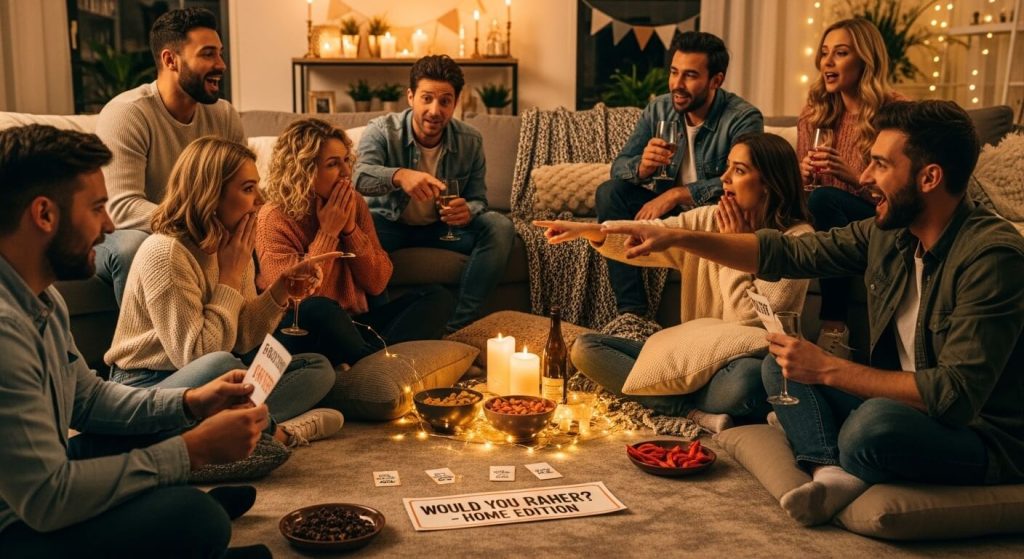
16. Would You Rather? (Home Edition)
No materials, no setup, no prep — just a list of home-themed “Would You Rather” questions and a room full of people ready to have opinions. Some questions to get started: Would you rather have a home theater or a giant walk-in library? Would you rather live with a leaky roof for a year or a broken heater for a month? Would you rather have a chef’s kitchen with no dining room, or a perfect dining room with a tiny kitchen? Would you rather live next door to the world’s friendliest neighbor or the world’s quietest one?
Guests answer and explain their reasoning, and that’s where the real fun lives. Debates get surprisingly passionate. You’ll learn things about your guests’ values and priorities that never would have come up in regular conversation.
Who It Works Best For
This is the most flexible game on the list in terms of group size — it works just as well with 4 people as it does with 20. It’s fully family-friendly and requires absolutely no preparation from guests. Because questions can be made as light or as thoughtful as you want, you can calibrate the tone to match the energy of the room at any given point in the evening.
How Much Time and Setup You’ll Need
Runs 10 to 20 minutes as a dedicated activity, though it often spills organically into regular conversation and continues on its own. Zero materials needed. Just have your questions ready in your head or jotted on your phone. Truly one of the best free housewarming party games that requires nothing at all.
When to Play It and Where It Fits
This is your perfect filler game. Use it anytime the energy dips, when you’re waiting for everyone to finish eating, or as a transition between bigger activities. Works indoors or outdoors, in any size home. You can start a round mid-conversation without any formal announcement — just ask the first question and let it run.
17. Cooking Challenge
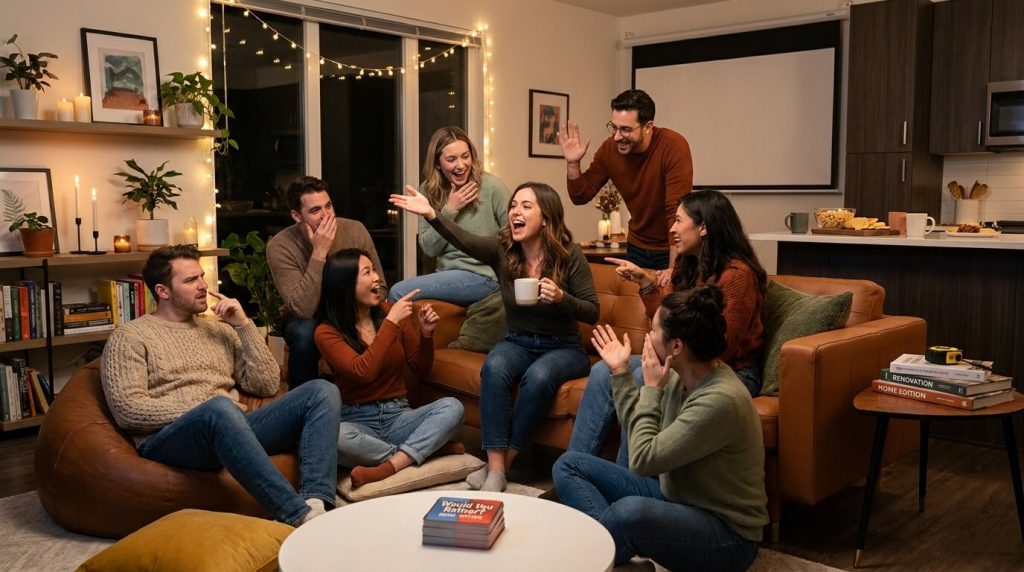
For groups that love food — and most do — a mini cooking challenge is one of the most genuinely entertaining housewarming party ideas for adults you can host. The format is intentionally flexible: “Best Toast Topping” where guests create combinations from a spread of ingredients laid out on the counter, or “Mystery Ingredient Dip” where guests use whatever’s already in the fridge to make something scoopable and delicious. Set a 10-minute time limit, have everyone taste, then vote on the winner.
This works especially well in open-concept kitchens where guests can gather around, watch, and cheer each other on. The mess is minimal, the results are usually surprisingly good, and there’s always at least one combination that nobody expected to work but absolutely does.
Who It Works Best For
Best for adult groups of 4 to 10 where guests are comfortable in a kitchen setting. Because the challenge involves heat, sharp tools, or raw ingredients depending on the format, it’s generally adult-oriented. For family parties, adapt the challenge to a no-cook format — toast toppings, cheese board assembly, or dip mixing — so kids can participate safely alongside adults.
How Much Time and Setup You’ll Need
The active challenge runs 20 to 30 minutes including tasting and voting. Setup involves laying out ingredients and clearing a prep area, which takes about 10 minutes. You’re largely using what you already have in your kitchen, so the materials cost is minimal — just factor in a few extra pantry staples when you do your party shopping.
When to Play It and Where It Fits
Mid-party is the sweet spot for this one — after guests have arrived and settled in but before the evening winds down. Kitchen access is required, which is worth stating clearly. This game doesn’t work well in homes with small, closed-off kitchens where only one or two people can operate at a time. For apartment parties, the no-cook format solves this entirely and keeps everyone in a comfortable space.
18. Housewarming Memory Jar
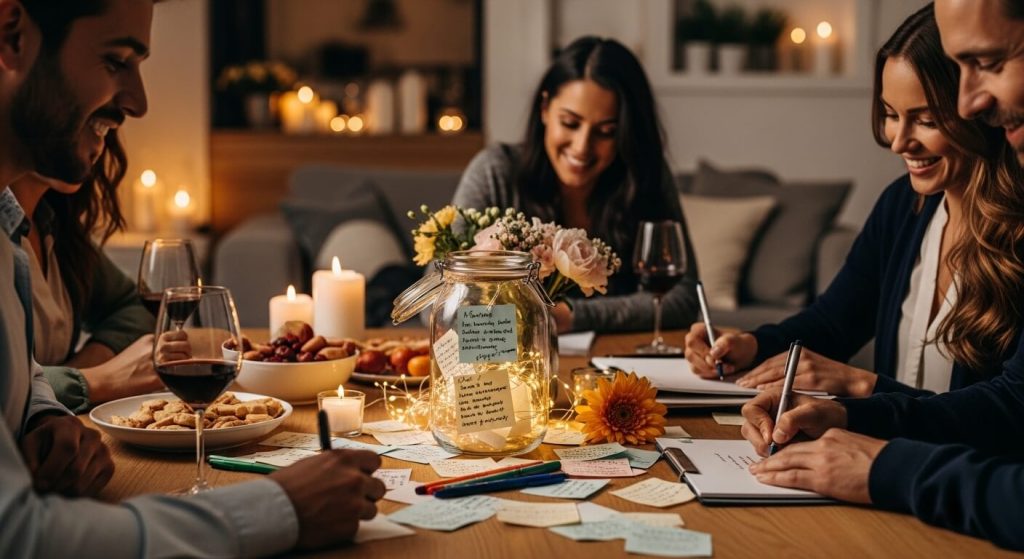
End the night with something that lasts long after the party is over. Set out a decorative jar, a stack of note cards, and pens near the entrance or your main gathering spot. Throughout the evening — or right before guests head home — each person writes a message for you. It might be a heartfelt wish for your life in this new space, a funny prediction about what will happen in this house, a memory they hope you’ll make here, or simply something kind they want you to carry with you.
You can read the notes aloud at the end of the party as a warm closing ritual, or save the jar for the next morning when the quiet sets in and you want a reminder of everyone who helped you celebrate. Either way, it becomes one of the most treasured things from the entire night — guests love the ritual of contributing, and hosts love having something tangible to return to.
Who It Works Best For
This activity works for any group size and is fully family-friendly — kids, grandparents, coworkers, and college friends can all participate equally. Even shy guests who prefer to stay quiet during group games are often the ones who write the most meaningful notes. There’s no competition, no performance, no pressure. Just a moment to say something genuine.
How Much Time and Setup You’ll Need
Individual contributions take about two to three minutes per person. Setup takes five minutes: buy or find a decorative jar, set out note cards and pens, and you’re done. Total cost is under five dollars if you don’t already have a jar at home. One of the most meaningful yet easiest-to-execute housewarming party activities on this list.
When to Play It and Where It Fits
Set the jar up at the very start of the party so guests have the whole evening to contribute when inspiration strikes, rather than rushing through it at the door on their way out. Works in any space — indoors or outdoors, small apartment or large home. The jar just needs a visible, accessible spot where guests will naturally pass by throughout the night. Of all the housewarming games and activities here, this is the one you’ll still have sitting on your shelf a decade from now.
How to Build Your Game Lineup for the Night
You don’t need to play all 18 games — and you probably shouldn’t try. Three to five games, chosen thoughtfully, will create a better evening than a packed schedule that rushes guests from one activity to the next. Here’s a structure that works consistently well for a three-hour housewarming party.
Opening — First 30 Minutes
Start with a low-stakes activity that guests can join as they arrive without disrupting anyone already playing. Home Trivia Challenge, Name That Room, and the Homeowner’s Bucket List all work well here because they’re easy to explain mid-round and guests can drift in naturally. The goal is simply to give people something to do while the room fills up.
Mid-Party — One to Two Hours In
Once everyone has arrived and the energy is at its peak, bring out your main event games. Pick one or two higher-energy activities — Housewarming Pictionary, the Scavenger Hunt, the Cooking Challenge, or Who Knows the Homeowners Best? — and let them run fully. This is the heart of the party, so give these games the time they deserve rather than rushing through them.
Late Evening — Final Hour
Wind down with storytelling-based housewarming activities that create genuine connection. The Memory Lane Story Swap, the Cozy Storytelling Circle, or a relaxed round of Would You Rather? all work beautifully when the energy has naturally shifted from active to reflective. These games work best when guests are settled in and comfortable enough to actually share something real.
Running Throughout the Evening
The Memory Jar and the Homeowner’s Bucket List don’t need a dedicated time slot. Set them up at the start of the party and let guests contribute whenever inspiration strikes throughout the night. Read the bucket list submissions aloud at a natural pause, and save the memory jar notes for the closing moments — or the quiet morning after.
Final Thoughts
A housewarming party is about more than showing off a new space. It’s about filling that space with the people and the moments that will make it feel like home. The right housewarming party games create the conditions for exactly that — naturally, without anyone feeling forced into having fun.
Whether you go with something laugh-out-loud funny like the junk drawer guessing game, something hands-on like the DIY welcome mat activity, or something quietly meaningful like the memory jar, the goal is the same: connection. Guests who leave a well-run housewarming party don’t just feel like they’ve seen your new home. They feel like they’ve been part of the beginning of your story in it.
Which of these housewarming game ideas are you most excited to try? Leave a comment below — we’d love to hear how your party goes.
If you love hosting lively celebrations, don’t miss these sizzling summer party ideas filled with creative themes, fun activities, and unforgettable entertainment inspiration.