
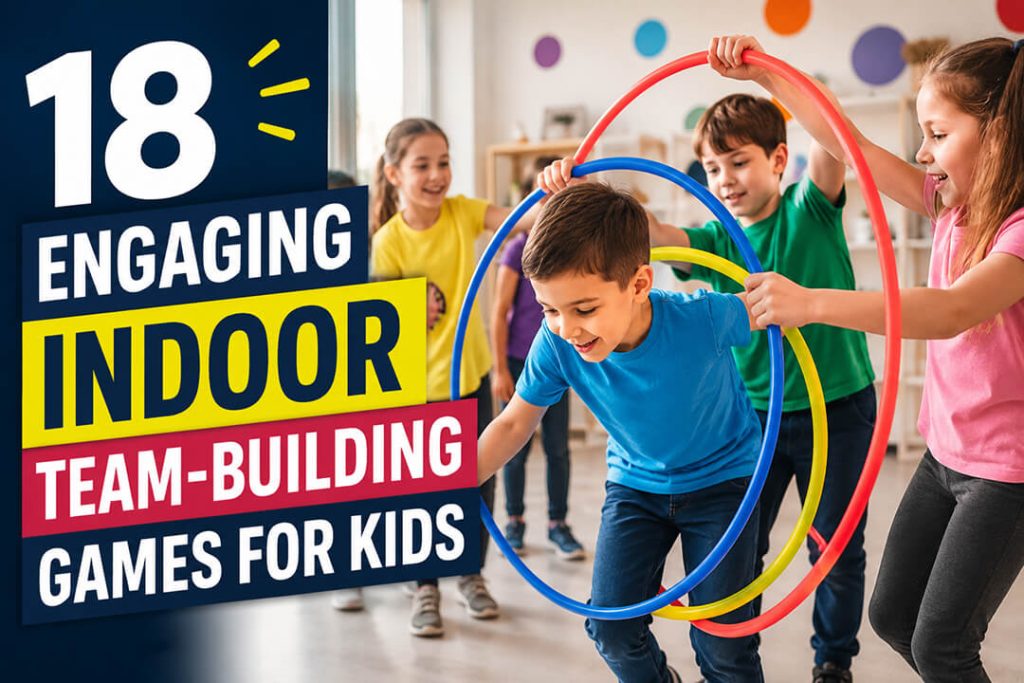

Teamwork is one of the most important life skills kids can learn. Whether it’s in classrooms, sports, or family life, the ability to cooperate, communicate, and support one another sets children up for success. But teamwork doesn’t develop by itself — it grows through shared experiences, laughter, and problem-solving.
That’s why indoor team-building games for kids are so powerful. They take the fun of play and mix it with opportunities to learn collaboration, patience, and leadership. Even in small classrooms or living rooms, kids can engage in activities that teach them how to listen, compromise, and celebrate wins as a group.
Here are 18 fun, engaging team-building games designed especially for kids indoors. Each activity sparks connection while building life-long social skills.
Tips for Running Indoor Team-Building Sessions
For best results, mix different types of activities: start with an easy, low-pressure game to break the ice, move into a more creative or problem-solving challenge, and finish with a reflective or kindness-focused activity. Keep supplies simple, rotate leadership roles so every child gets a chance to guide, and always celebrate the process more than the outcome. The goal isn’t perfection — it’s shared effort, laughter, and bonding.
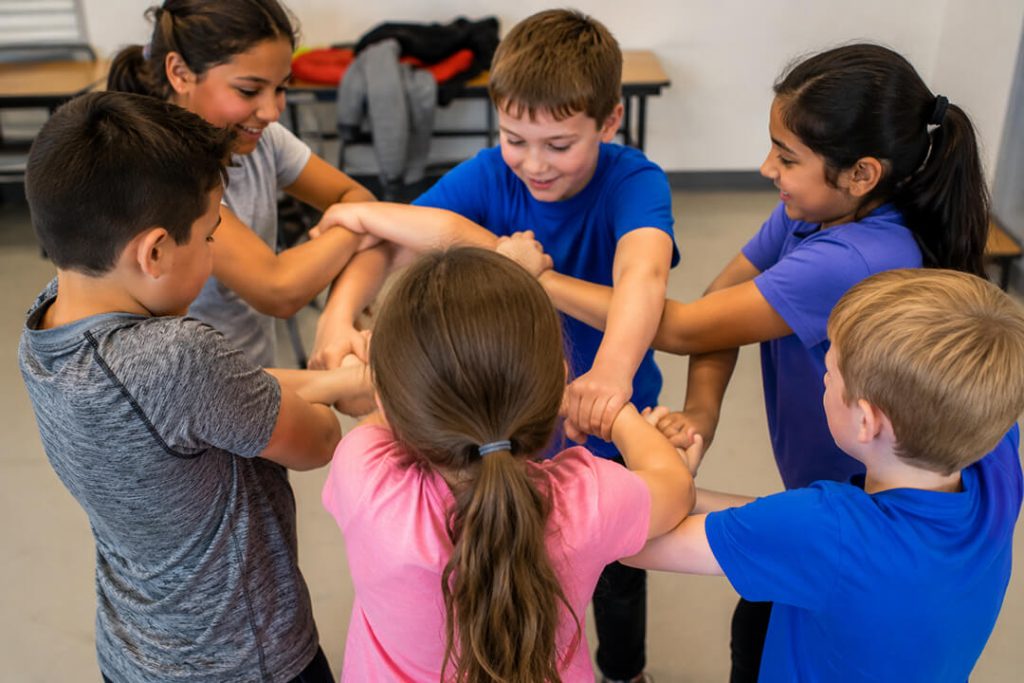
1. Human Knot
How It Works: Kids stand in a circle, reach across to grab two different hands, and then work together to untangle themselves without letting go.
Why It Builds Teamwork: Success requires communication, patience, and problem-solving. Kids learn that rushing won’t work — they must cooperate to get untangled.
Pro Tips:
-
Use smaller groups (6–8 kids) for younger ages.
-
Encourage kids to take turns leading suggestions (“step over here,” “duck under”).
Difficulty: Moderate | Cleanup: None.
2. Tower Builders
How It Works: Divide kids into teams. Provide materials like cups, blocks, or cardboard tubes. Each team must build the tallest freestanding tower within 10 minutes.
Why It Builds Teamwork: Kids brainstorm designs, assign roles (builder, stabilizer, supplier), and celebrate their creation.
Variations:
-
Add a “twist” like building without speaking.
-
Judge not only height but creativity.
Difficulty: Easy | Cleanup: Reset materials.
3. Puzzle Relay
How It Works: Teams receive jigsaw puzzle pieces mixed in with other teams’. They must cooperate to find their correct pieces, then assemble the puzzle.
Why It Builds Teamwork: Kids practice negotiation and trading while learning patience.
Hosting Insight: Choose age-appropriate puzzles — larger pieces for younger kids, more complex designs for older groups.
Difficulty: Easy | Cleanup: Puzzles back in box.
4. Pass the Energy
How It Works: Kids stand in a circle. One child claps and passes the clap around as quickly as possible. Variations include adding words, movements, or changing directions.
Why It Builds Teamwork: It emphasizes rhythm, attention, and awareness of others.
Pro Tips:
-
Add music to increase energy.
-
For older kids, turn it into a timed challenge.
Difficulty: Easy | Cleanup: None.

5. Balloon Team Juggle
How It Works: Groups must keep several balloons in the air at once, working together to stop them from touching the floor.
Why It Builds Teamwork: Everyone must participate — if one person slacks, the balloon falls. It teaches shared responsibility.
Safety Note: Clear space to prevent tripping.
Difficulty: Moderate | Cleanup: Balloons afterward.
6. Story Chain Builders
How It Works: One child starts a story with one sentence. Each child adds a sentence until the group creates a full story.
Why It Builds Teamwork: Kids practice listening, building on others’ ideas, and creative thinking.
Pro Tip: Record the final story and read it aloud for laughs.
Difficulty: Easy | Cleanup: None.
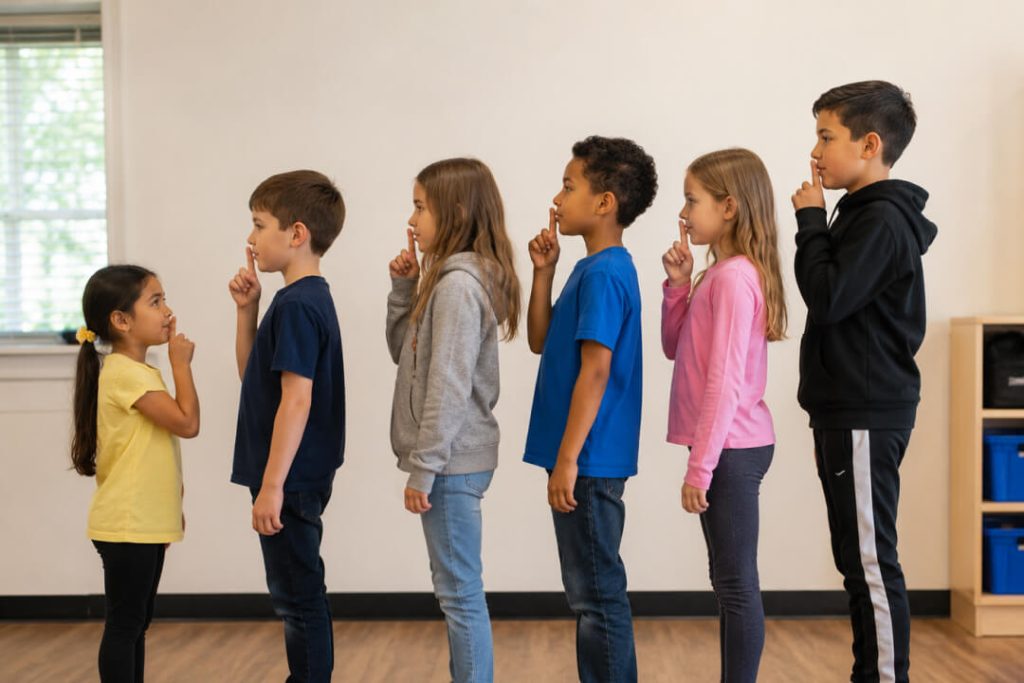
7. The Silent Line-Up
How It Works: Without speaking, kids must line up by height, birthday month, or shoe size.
Why It Builds Teamwork: Forces non-verbal communication and observation. Kids must rely on gestures and cooperation.
Pro Tips:
-
For younger kids, start with simpler categories.
-
For older kids, add a timer for extra challenge.
Difficulty: Easy | Cleanup: None.
8. Blanket Flip Challenge
How It Works: A group stands on a blanket. Without stepping off, they must flip the blanket completely over.
Why It Builds Teamwork: Requires problem-solving, patience, and lots of laughter.
Hosting Insight: Works best with small groups and large blankets.
Difficulty: Moderate | Cleanup: Fold blankets afterward.
9. The Trust Walk
How It Works: One child is blindfolded and guided through a short obstacle path by a partner’s verbal instructions.
Why It Builds Teamwork: Builds trust, listening skills, and careful communication.
Safety Note: Keep obstacles soft and safe (pillows, chairs).
Difficulty: Easy | Cleanup: Minimal.
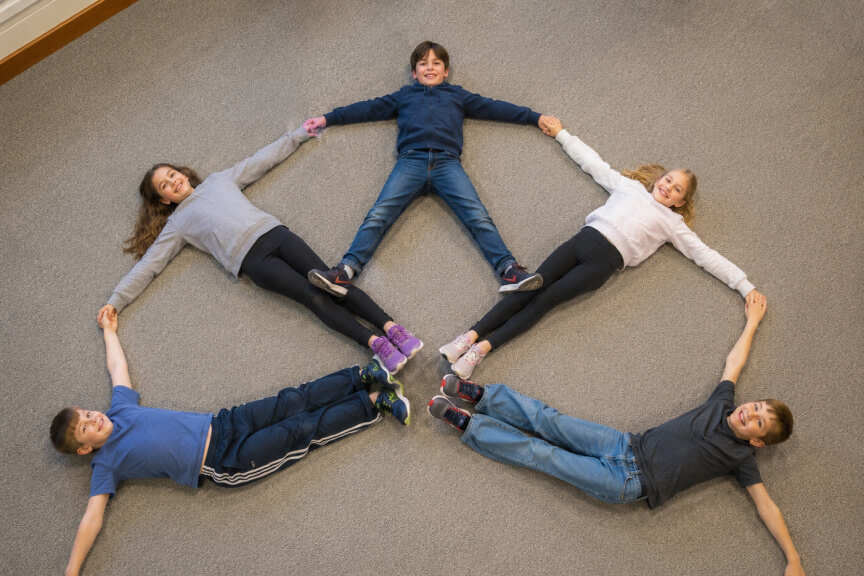
10. Shape Shifters
How It Works: Teams lie on the ground and use their bodies to form shapes (a star, a house, a letter).
Why It Builds Teamwork: Success depends on coordinating positions and visualizing as a group.
Pro Tip: Snap photos for fun memories.
Difficulty: Easy | Cleanup: None.
11. Cup Stack Relay
How It Works: Teams race to stack and unstack cups in set patterns. Each player takes a turn before passing it on.
Why It Builds Teamwork: Encourages speed, focus, and turn-taking.
Variations: Try with eyes closed, guided by teammates’ instructions.
Difficulty: Easy | Cleanup: Reset cups.
12. The Cooperative Maze
How It Works: Use tape on the floor to create a grid. One child must navigate the “maze” with the team giving clues.
Why It Builds Teamwork: Kids learn to guide, listen, and strategize as a group.
Pro Tips:
-
Add “traps” for extra challenge.
-
Rotate leaders to share responsibility.
Difficulty: Moderate | Cleanup: Remove tape.
13. Paper Chain Factory
How It Works: Teams get paper and tape. They must create the longest continuous paper chain in 10 minutes.
Why It Builds Teamwork: Kids must divide roles (cutting, folding, taping) and cooperate under time pressure.
Hosting Insight: Use colorful paper for visual fun.
Difficulty: Easy | Cleanup: Recycle paper.

14. The Message Relay
How It Works: Like “telephone,” but instead of words, kids draw a simple picture and pass it along for others to copy.
Why It Builds Teamwork: Highlights the importance of clear communication.
Pro Tips:
-
Choose simple shapes (house, cat) to start.
-
Compare the first and last pictures for laughs.
Difficulty: Easy | Cleanup: Collect papers.
15. Hoop Pass
How It Works: Kids stand in a circle holding hands. A hula hoop must be passed around without breaking the chain.
Why It Builds Teamwork: Teaches problem-solving and persistence while sparking giggles.
Pro Tip: Add two hoops moving in opposite directions for older groups.
Difficulty: Easy | Cleanup: None.
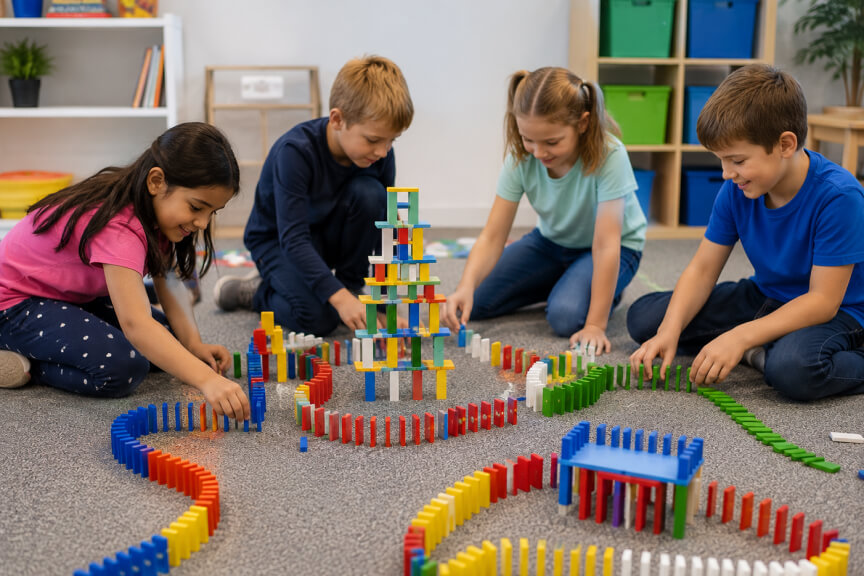
16. Domino Builders
How It Works: Teams use dominoes (or blocks) to build creative domino runs. The longest run wins.
Why It Builds Teamwork: Teaches patience, planning, and careful cooperation.
Hosting Insight: Celebrate both success and funny fails when dominoes collapse too soon.
Difficulty: Moderate | Cleanup: Reset pieces.
17. The Compliment Web
How It Works: A ball of yarn is tossed around. Each child gives a compliment to the person they pass it to, holding onto their piece of yarn. By the end, a “web” connects the group.
Why It Builds Teamwork: Reinforces positivity, appreciation, and group unity.
Pro Tip: Works beautifully as a classroom closing activity.
Difficulty: Easy | Cleanup: Roll yarn back up.
18. The Group Balance
How It Works: Teams must balance an object (like a beach ball) on a blanket and move it across the room without dropping it.
Why It Builds Teamwork: Encourages coordination and shared responsibility.
Safety Note: Use lightweight objects to avoid accidents.
Difficulty: Moderate | Cleanup: Minimal.

FAQs About Indoor Team-Building Games for Kids
Q1: Why are team-building games important for children?
They teach life skills like communication, empathy, leadership, and problem-solving. Games provide a safe environment where kids practice cooperation while having fun. These lessons transfer into school, sports, and friendships.
Q2: How much space do I need for these games?
Most require minimal space — a classroom, living room, or gym works fine. The focus is on cooperation, not running. Clear a small area and remove fragile items before starting.
Q3: What age group are these games for?
Most activities here suit ages 6–12. For younger kids, simplify tasks (fewer puzzle pieces, shorter towers). For older kids, add complexity or time limits.
Q4: Can teachers use these in classrooms?
Yes! Many teachers use team-building games at the start of the year, after breaks, or before group projects. They help reduce shyness, build community, and boost collaboration.
Q5: Do I need special supplies?
Not at all. Most games use everyday items like cups, paper, balloons, or blankets. A simple “game supply box” can keep everything organized.
If you’re working with a tighter space and want even more inspiration, check out these 19 engaging games perfect for small living rooms — they’re simple, fun, and designed to keep kids laughing and connecting without needing much room to play.
Final Thoughts
Team-building isn’t just about fun — it’s about shaping kids into cooperative, empathetic individuals. These 18 engaging indoor games offer opportunities for laughter while building trust, patience, and group spirit.
Whether you’re a teacher, parent, or youth leader, you can use these activities to create moments of connection. Small rooms, simple props, and one shared goal are all it takes to teach kids that working together is always better than working alone.
So next rainy day or classroom break, pick one of these games. Watch as kids learn to celebrate not just their own success, but the joy of achieving something as a team.



I teach a young, small group of kiddos and I am teaching them the many facets of gaming ie teamwork, sportsmanship, communication and the like. These games are perfect! Thank you!
This comment made me smile, thank you! It’s especially rewarding to hear the games are helping with things like communication and sportsmanship, since that’s exactly what I hoped they’d do. I’d love to hear how your kiddos respond to them if you ever want to share and if you’re looking for more activities along these lines, let me know what age group you’re working with and I can point you toward a few others that might work well too.