
If you have ever walked into a room full of strangers, awkward silences, and politely frozen smiles, you already know why icebreaker games matter. Whether you are running a team meeting, leading a classroom orientation, organizing a youth retreat, or hosting a party, the right activity in the first five minutes can completely change what happens in the next two hours. That is not an exaggeration. The opening minutes of any group gathering set a social contract that either opens people up or quietly tells them to stay guarded.
This guide covers 16 creative, genuinely enjoyable icebreaker activities that work across different group sizes, energy levels, and settings. Every one of them comes with real instructions, practical facilitator notes, and honest insight into how they tend to play out in actual sessions, not just in theory.
Why Icebreaker Games Actually Matter (More Than You Think)
There is a persistent misconception in workplaces and schools alike that icebreakers are a formality. Something you do because someone told you to, a box to tick before the real agenda begins. That framing misses what is actually happening in those first minutes.
When people enter a new group setting, the social brain runs a quiet background process: Is this place safe? Will I be judged? Who is in charge here? These are not dramatic thoughts. They are automatic. And until something interrupts that process, most people stay in low-trust mode, which means shorter answers, less creative thinking, and a reluctance to speak up when it actually counts.
Research on group dynamics and psychological safety consistently shows that teams who share even a brief positive experience before structured work engage more fully and collaborate more effectively. A five-minute warm-up changes the chemistry of a room, not because it is magic, but because it shifts people from evaluating the situation to actually being present in it.
This matters especially in professional settings, where adults often feel pressure to appear competent and composed rather than curious and a little playful. A well-chosen activity gives them permission to be human before the meeting agenda takes over.

What Separates a Good Icebreaker from a Forgettable One
Not every icebreaker earns its time. You have probably experienced the bad kind: going around a circle, each person stating one fun fact while everyone else quietly waits their turn. The energy stays flat and the facts are forgotten by the time the meeting starts.
The problem is not the format exactly. It is that there is no shared experience happening. Each person performs briefly for the group, and then it is someone else’s turn. Nobody is in it together.
The activities that actually land share a few common traits. They give people a real reason to interact that feels natural rather than manufactured. They have a low entry barrier, so no one has to perform or demonstrate anything special to participate. They are time-bounded enough that momentum stays up. And critically, they match the size and context of the group. An activity that works beautifully for eight people in a conference room will often collapse with eighty people in a ballroom.
Keep these characteristics in mind as you look through the games below.
The 16 Best Creative Icebreaker Games
1. Two Truths and a Lie (The Classic, Done Right)
Almost everyone has played this one. Most people have also experienced the version that goes completely flat, where each person states their three items, the group makes a half-hearted guess, and then you move on with barely any real conversation.
How to run it well: The fix is surprisingly simple. Instead of going around the room sequentially, have everyone write their three statements on an index card or sticky note first. Collect them, shuffle the pile, and read each one aloud anonymously while the whole group guesses together. Only after voting does the author reveal themselves.
Two things happen that do not happen in the standard version. Everyone stays engaged the entire time because they are guessing on every single card, not waiting for their own turn. And quieter participants suddenly receive attention without having to claim it. In sessions run with new employee cohorts and conference groups, it is consistently the most reserved person in the room who produces the most surprising statement. That moment of revelation does real social work.
Facilitator note: Ask people to write their statements before anyone else shares, so they are not trying to one-up each other mid-activity.
Group size: 8 to 30 people. Time: 10 to 15 minutes.
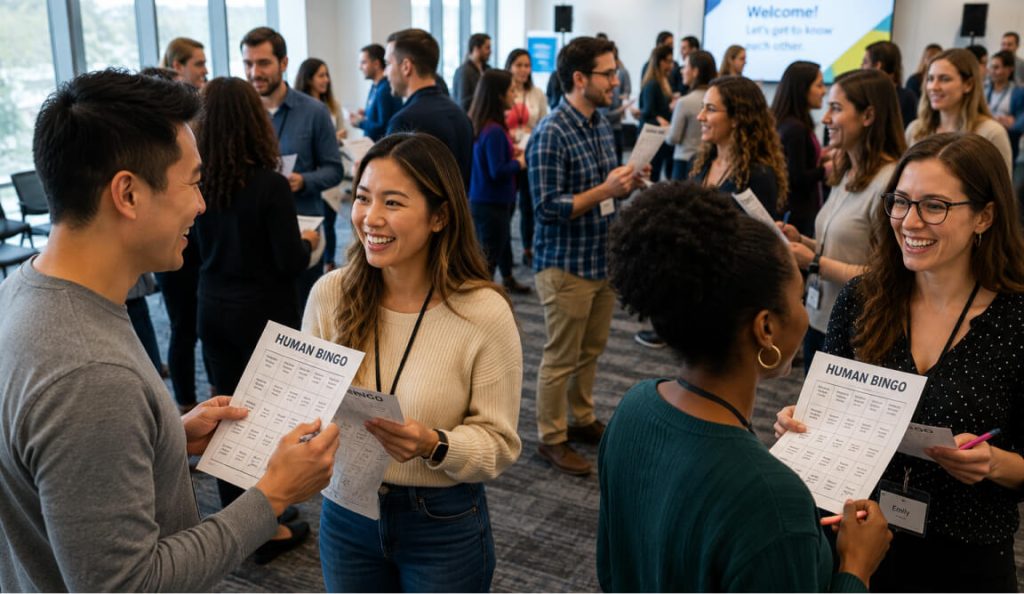
2. Human Bingo
For medium to large groups, this one reliably solves the hardest problem at scale: getting people to actually speak to strangers rather than gravitating toward the two or three colleagues they already know.
How it works: Print bingo cards where each square contains a descriptor. Something like “has lived in three different states,” “speaks more than one language,” “has never eaten sushi,” or “can play a musical instrument.” Participants circulate around the room, find someone who fits each description, and collect their signature in that square. First to complete a row wins.
What tends to happen in practice is that people forget they are doing an icebreaker about halfway through. They are simply talking to whoever is nearby, with the card providing a ready-made reason to approach anyone in the room. At conferences and orientation events, these conversations regularly continue well past the activity itself.
One practical note: keep your descriptors diverse and genuinely inclusive. Avoid anything that might make participants feel excluded or put on the spot. The goal is to surface interesting and unexpected common ground.
Group size: 15 to 100 people. Time: 10 to 20 minutes.
3. The Marshmallow Challenge
This is less of a warm-up activity and more of a full group exercise that happens to work brilliantly as an opener. It is physical, mildly competitive, and reveals team dynamics in roughly twenty minutes in ways that a formal debrief exercise might take hours to uncover.
How it works: Divide into teams of four. Each team receives 20 pieces of dry spaghetti, one yard of tape, one yard of string, and one marshmallow. Objective: build the tallest freestanding structure possible in 18 minutes, with the marshmallow placed on top at the end, not held in place by hand.
Almost every team makes the same mistake. They spend the first fifteen minutes planning carefully, then place the marshmallow at the final moment only to watch the whole structure buckle under its weight. The teams that tend to succeed are those who test early, fail small, and keep adjusting throughout.
The debrief is genuinely worth the time. It often produces honest conversation about planning versus doing, who naturally took the lead, and what assumptions the group brought into the task. Run this before a workshop on communication or creative problem-solving and it sets up the learning in a way no slide presentation can replicate.
Group size: 8 to 40 people in teams of 4. Time: 25 to 30 minutes including debrief.
4. Commonalities
This one tends to get underestimated because it sounds simple, but groups frequently come out of it genuinely surprised by each other. The idea is straightforward: people feel connected when they discover shared ground, and there is almost always more of it than anyone expected.
How it works: Pair people up or put them in groups of three. Give them five minutes to find five things they all have in common that are not visible or obvious. “We all breathe” does not count, and neither does “we all work here.” The constraint forces people to dig a little, asking about childhood experiences, food preferences, travel history, or hidden skills.
When groups report back to the room, there is usually a moment of genuine surprise. “Wait, you too?” about something nobody would have guessed. That moment does a lot of social bonding work in a short time. The activity works particularly well with teams who have worked together for months but mostly know each other’s job titles, not much else.
Group size: 6 to 30 people. Time: 10 to 15 minutes.

5. Name and Motion
Learning twenty new names in ten minutes sounds impossible. This format actually makes it happen, mostly because it turns the task into a collective physical exercise rather than a solo memory challenge.
How it works: Everyone stands in a circle. One person says their name paired with a physical motion of their choosing: a wave, a spin, a clap, a jump, anything goes. The entire group mirrors both the name and the motion back together. Once everyone has gone, do a second round where each person must perform every previous name-and-motion combination before adding their own.
By the time you reach the last person in the second round, the room is usually in some degree of happy chaos. Someone has blanked on the third motion, and the whole group is trying to quietly coach them. That shared moment of collective struggling-but-laughing is precisely what builds rapport fast. Youth groups and classroom settings respond especially well because the physical element creates an energy that purely verbal activities rarely match.
Facilitator note: Do not skip the second round. That is where the real payoff happens.
Group size: 8 to 25 people. Time: 10 to 15 minutes.
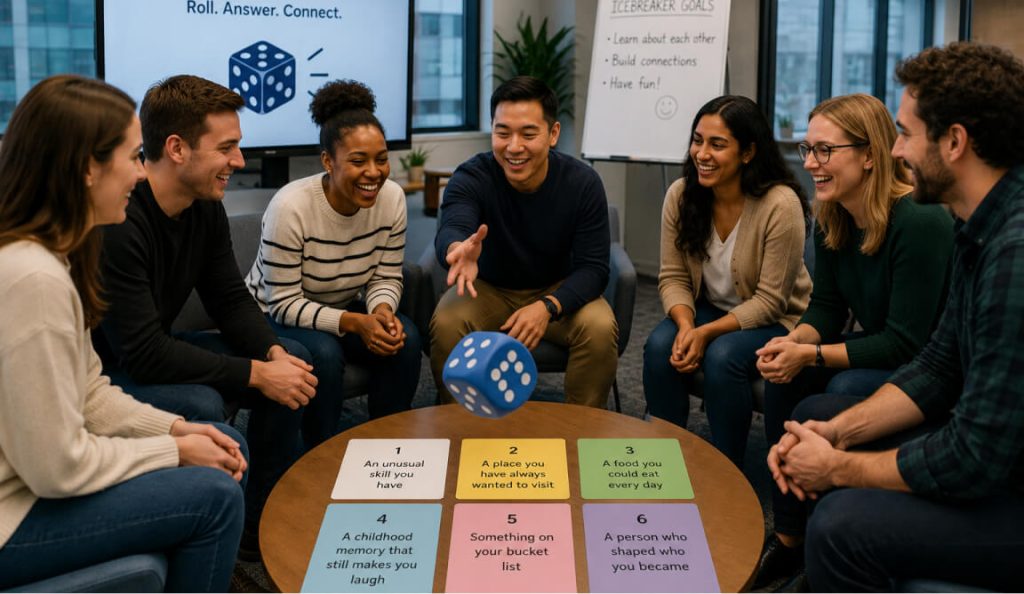
6. Dicebreakers
Roll a die, answer a prompt. The concept is simple, and it consistently works across very different group types, from corporate workshops to casual social gatherings, precisely because it removes the pressure of deciding what to share.
How it works: Prepare a prompt list where each number on a standard die maps to a question category. For example: 1 = an unusual skill you have, 2 = a place you have always wanted to visit, 3 = a food you could eat every single day, 4 = a childhood memory that still makes you laugh, 5 = something on your bucket list, 6 = a person who shaped who you became. Each participant rolls and answers whatever they land on.
The randomness does the social heavy lifting. Nobody has to choose what to reveal. The die picks for them, and that simple removal of choice makes people significantly more willing to give a real answer. Because the prompts are personal without being intrusive, participants tend to share things that reveal genuine personality rather than rehearsed fun facts.
The format translates naturally to virtual settings. Use an online dice roller on a shared screen and the structure works identically.
Group size: 6 to 30 people. Time: 10 to 20 minutes.
7. Speed Networking
The name sounds slightly corporate, but in practice this is one of the most reliably energizing formats for larger groups, especially at professional events where people spend the whole day talking to the same three colleagues they arrived with.
How it works: Arrange two rows of chairs facing each other, or two concentric circles. One side stays stationary; the other rotates every 90 seconds on the facilitator’s signal. During each pairing, participants respond to the same rotating prompt. Good ones include: “What is something you are working on that genuinely excites you right now?” or “What is one thing about your work that people outside your field would find surprising?”
The tight time constraint is actually what creates authenticity. People stop performing for an impression and just talk, which produces far more genuine exchanges than a full-length conversation at the start of an unfamiliar day. Attendees at conferences where this has been run consistently comment afterward that they felt like they truly met more people in twenty minutes than they typically would across an entire event.
Group size: 16 to 100 people. Time: 15 to 25 minutes.
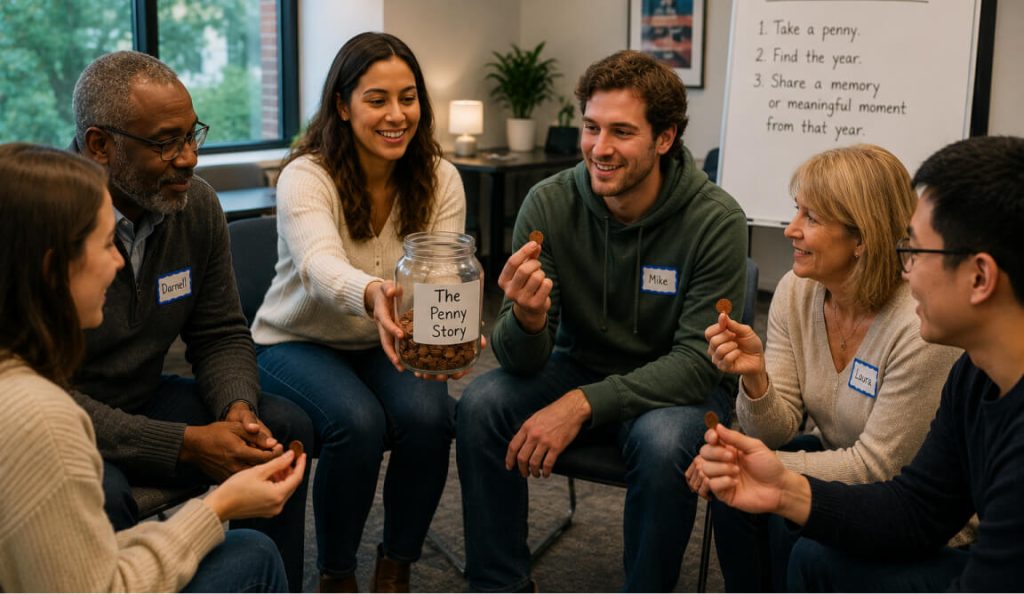
8. The Penny Story
No printing, no setup, no preparation beyond grabbing a jar of coins. Yet this is one of the most reliably moving activities on the entire list, and it works with almost any age group.
How it works: Pass around a jar of pennies. Ask each person to take one without looking at the date yet. Once everyone has a coin, they flip it, find the year, and share a memory or meaningful moment connected to that year. If the coin predates their birth, they can describe what the world was like then or share a family story from that era.
What tends to happen is that people end up sharing things they would never have offered in a standard introduction round. The year a parent passed away. The year they emigrated. The year they had their first child. The penny is just a prop, but it gives people a concrete anchor for something personal that they might not otherwise have a reason to share.
There is also a generational connection element that no other activity produces quite as naturally. A younger participant discovers their coin year was the same year an older colleague got their first job. These small intersections of personal history are unexpectedly powerful in building a sense of collective identity.
Group size: 8 to 40 people. Time: 15 to 20 minutes.
9. Whose Story Is It?
This works especially well with groups that have been together for a while but still operate mostly on the surface. It reliably surfaces the fact that people are far more interesting than their professional persona lets on.
How it works: Before the session, reach out to five or six volunteers and ask each one to privately submit a single surprising or unusual true story from their life. During the activity, the facilitator reads these stories aloud without naming the author, and the group votes on whose story they think each one is. All reveals happen together at the end.
The results tend to produce genuine disbelief. The quiet team member who never volunteers anything in meetings once lived on a sailboat for eight months. The straightforward operations lead competed nationally in swing dancing at 40. These are the kinds of details that permanently shift how colleagues see each other, and that shift matters for collaboration, communication, and team culture in lasting ways.
This requires a little advance coordination, but it is worth the effort. Encourage people to choose something genuinely unexpected rather than a surface-level quirk.
Group size: 10 to 40 people. Time: 15 to 25 minutes.
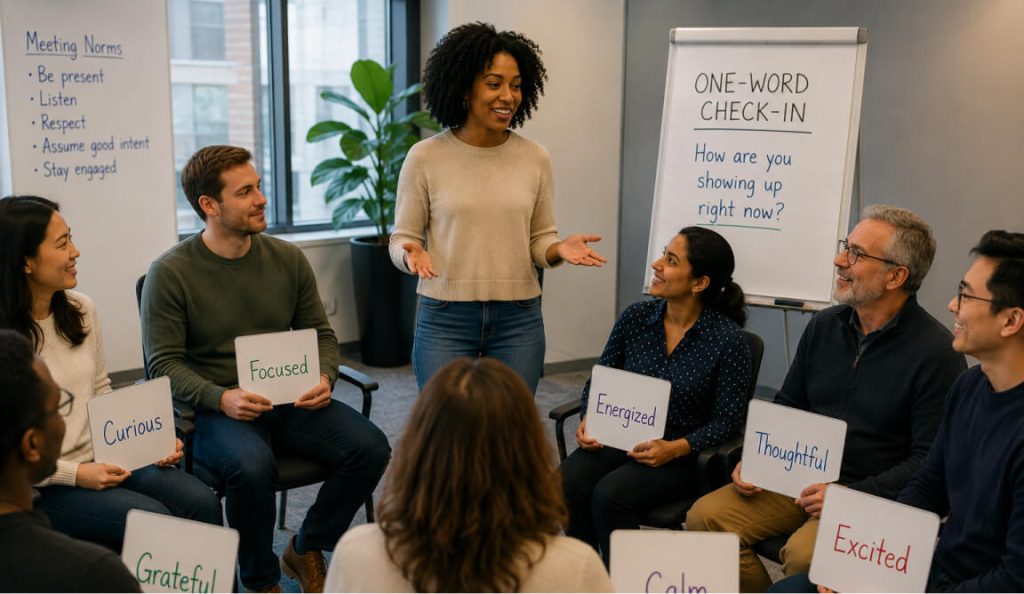
10. One-Word Check-In
For sessions where time is short but you still want people arriving mentally present rather than halfway through their previous meeting, this format does more than its simplicity suggests.
How it works: Go around the room and ask each person to share exactly one word describing how they are showing up right now. No elaboration required, though people can add a sentence if they feel like it. After the round, the facilitator briefly reflects on what came up: “Sounds like many of us are arriving stretched, so let us be intentional about how we use the next hour.”
What actually happens is that every person receives one moment of undivided group attention. In most meetings, the first few minutes are lost to phones, late arrivals, and mental carryover from whatever came before. This format interrupts that drift and activates collective presence in a way that a stronger warm-up might take ten minutes to achieve.
It also gives the facilitator real-time data. If the majority of the room says “overwhelmed” or “scattered,” that is useful information about how to pace and frame what comes next.
Group size: 5 to 50 people. Time: 3 to 8 minutes.
Want more screen-free fun at home? These indoor icebreaker games for families are perfect for sparking laughter, bonding, and unforgettable moments together.
11. The Map Activity
At retreats, conferences, or any session where building a shared sense of group identity matters, this is one of the most visually engaging and spontaneously conversation-generating activities available.
How it works: Hang a large map on the wall. World, national, or regional depending on your audience. Give everyone a sticker or a marker and ask them to place it on where they were born, where they grew up, or wherever feels most significant given the context. Then step back and let the room do the rest.
Small conversations ignite without any facilitation. Someone from a small town in Idaho discovers a colleague grew up in the next county. A group of colleagues who assumed most people were local realizes they represent eleven different countries between them. The visual impact of seeing the whole group’s geography plotted on a single map produces a genuine sense of collective identity that no verbal introduction can replicate.
For dispersed teams gathering in person, this can be particularly meaningful. Many remote or hybrid teams never quite develop a felt sense of their own geographic range until they actually see it in front of them.
Group size: 15 to 200 people. Time: 10 to 20 minutes.
12. This or That
Fast, requires nothing, adapts to almost any audience, and somehow stays fresh no matter how many times people have seen a version of it. The key is in how you build the prompts and how you run the debrief moments between choices.
How it works: Call out pairs of options. Participants physically move to one side of the room to represent their choice, or simply raise a hand if space is limited. Start with something light: cats or dogs, morning person or night owl, coffee or tea. Gradually move toward slightly more revealing choices: planner or spontaneous, big picture or detail-oriented, asks for help easily or figures it out alone. After each split, invite a few people from each side to briefly explain why.
The physical movement maintains energy and prevents the slow drift that happens in long seated sessions. But the more durable value is in the brief explanations. Those fifteen-second answers surface personality, values, and working styles in a format that feels entirely casual. By the time you have run eight or ten pairs, people have a surprisingly rich sense of who is in the room with them.
Also doubles as an effective re-energizer after lunch or a heavy stretch of content.
Group size: 8 to 100 people. Time: 5 to 15 minutes.

13. Desert Island Survival
This scenario-based activity sits at the intersection of imagination and negotiation, and it reveals a great deal about how people collaborate under mild pressure in ways that purely social activities rarely can.
How it works: Tell the group they are stranded on a desert island for 30 days. Each person may bring only three items. Give two minutes for individual thinking and writing. Then form small groups and instruct each group to negotiate a single collective list of five items to share among everyone. Groups then present their final list and explain their reasoning.
Watch what happens during the small group phase. Some people argue confidently and hold their ground. Others fold almost immediately. Some look for creative compromises. The stakes are zero, which is exactly why these dynamics surface honestly rather than defensively. A short reflection at the end, asking how the group made their decision, opens up genuine conversation about communication styles and collaborative decision-making in a way that feels natural because it is grounded in something that just actually happened.
Group size: 8 to 30 people. Time: 15 to 25 minutes.
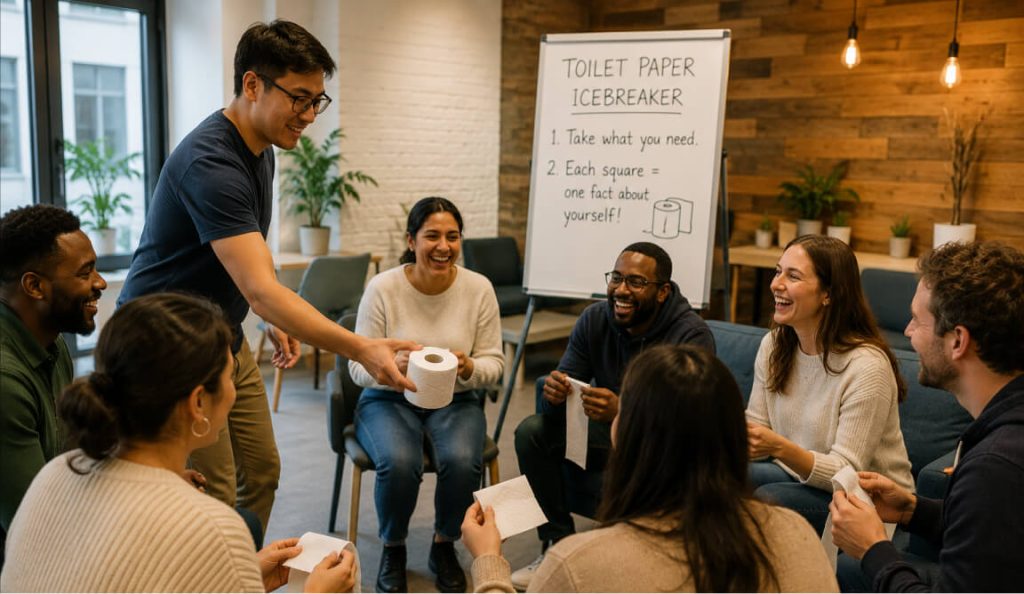
14. Toilet Paper Icebreaker
The name alone produces a reaction, which is part of why it works so consistently across such different types of groups.
How it works: Pass a roll of toilet paper around the room and tell people to take as much as they need. Offer no further explanation. Once everyone has their share, reveal that each square represents one fact they need to share about themselves. Two squares means two things. Eighteen squares means a very full turn.
The moment of realization, usually some combination of laughter and groaning and “I knew it,” does immediate social work. People who took a large amount end up sharing things they might never have volunteered in a structured introduction. The unpredictability is the point. Nobody can prepare or perform their way through it because they have no control over how much they committed to before understanding the rules.
It travels well to parties, orientation events, new hire onboarding, and anywhere a lighter, more playful tone is appropriate.
Group size: 8 to 40 people. Time: 10 to 20 minutes.
15. Icebreaker Puzzles
For groups where a significant portion of participants are introverted or analytical, or simply dread anything that resembles a social performance, task-based activities open a completely different entry point into connection.
How it works: Hand small groups of three or four a lateral thinking puzzle or a brainteaser. Give them five to seven minutes to work through it together. The puzzle content is almost secondary. What actually happens is that people start talking, debating, laughing at wrong guesses, and building on each other’s ideas, all before any formal introduction has taken place.
Quieter and more introverted participants tend to respond well to this format because the focus is on the problem rather than on presenting themselves. And once a group has worked through something tricky together for six minutes, the brief introductions that follow feel significantly less loaded. There is already a small shared history in the room to draw on.
Lateral thinking puzzles are readily available for free online. Choose ones with multiple possible approaches rather than a single trick answer, since the collaborative reasoning process is more valuable than reaching the solution.
Group size: 6 to 30 people in groups of 3 or 4. Time: 10 to 15 minutes.
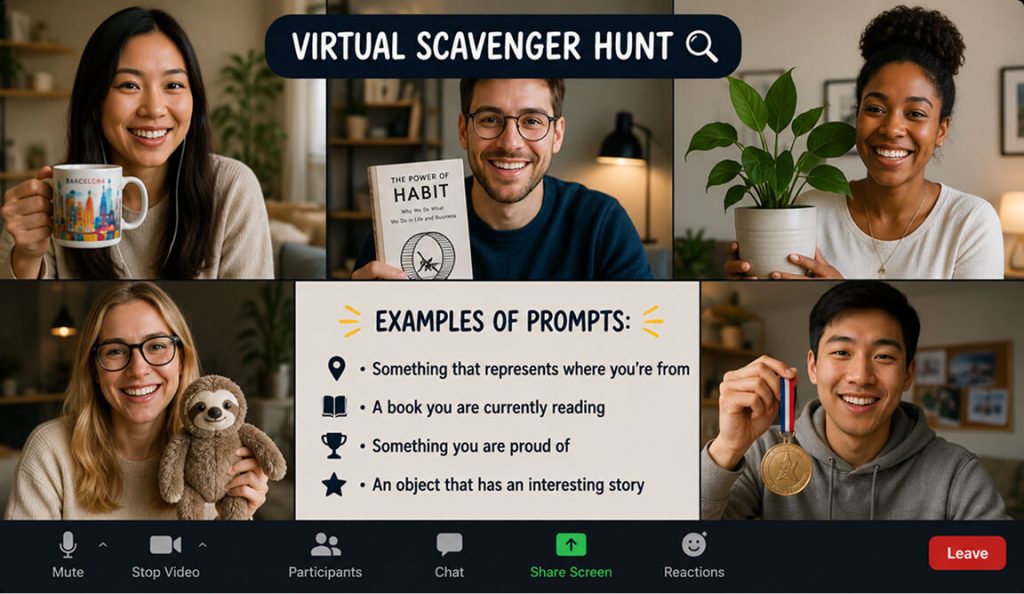
16. Virtual Scavenger Hunt
Most remote meeting icebreakers amount to going around the call saying your name, role, and one fun fact. Nobody particularly enjoys it. The Virtual Scavenger Hunt replaces that routine with something that actually generates genuine energy on a video call.
How it works: Call out a series of categories and give participants 60 seconds to grab something from their physical environment that fits. Examples: something that represents where you are from, a book you are currently reading, something you are proud of, an object that has an interesting story behind it. Each person holds it up on camera and shares a sentence or two about why they chose it.
The result is that you briefly see each other’s actual lives. A cluttered bookshelf behind someone. A handmade mug from a pottery class. A photograph pinned to the wall. These small glimpses build a sense of familiarity that several months of status-update calls rarely achieve on their own. Remote and hybrid teams are often far more geographically and culturally diverse than in-person ones, and this format lets that diversity become visible in a way that feels warm rather than performed.
Prompts are easy to customize based on the group’s purpose or culture.
Group size: 5 to 30 people. Time: 15 to 25 minutes.
Why These Activities Work Differently from Standard Icebreakers
The sixteen activities above share one important structural characteristic: they are all built around shared experience rather than sequential self-presentation. That distinction matters more than it might initially seem.
When a group goes around a circle sharing individual facts, each moment belongs to one person while everyone else waits. There is no collective reference point, no shared laugh, no single moment where the whole room is experiencing the same thing simultaneously. Every activity in this guide creates at least one of those shared moments, and those moments are the foundation of genuine group cohesion.
Experienced facilitators also notice something else: these activities consistently surface the less visible members of a group. The person who rarely speaks in a standard meeting often has the most remarkable Two Truths story. The team’s quietest thinker frequently wins the Marshmallow Challenge. When the opening of a session is designed to reveal that kind of depth, it permanently changes how people perceive and interact with each other for the rest of the day.
Best Time to Use These Activities
Timing matters as much as the activity itself. Even a strong format lands poorly when it is deployed in the wrong moment.
At the start of a brand-new group.
First meetings carry ambient social tension, especially in professional settings. A good warm-up does not eliminate that tension, but it gives people a structured, lower-stakes way to encounter each other before the real work begins.
Before collaborative or creative work.
Groups that have shared a laugh, negotiated desert island items together, or struggled collectively over a spaghetti structure approach collaborative tasks with notably more openness. The social warm-up is not separate from the work. It is preparation for it.
After a long stretch of content or following a break.
Attention and energy predictably dip after lunch and late in the afternoon. Even a brief physical activity like This or That reactivates presence in a way that another slide or talking-head segment cannot.
When welcoming a new member into an established group.
Existing teams develop their own culture and internal shorthand. Without a deliberate warm-up, a new person spends the whole session trying to decode the room rather than participating in it.
Tips for First-Time Facilitators
Running your first group activity can feel more nerve-wracking than expected. You are asking a room full of people to step outside their normal behavior, and the facilitator’s visible comfort directly affects how the group responds. A few things help.
Read the room before you pick the activity.
Tired attendees at the end of a long travel day need something gentle and brief. A high-energy youth group needs something physical. Matching the activity to where people actually are, rather than where you hope they will be, makes an enormous difference.
Give clear, brief instructions before you start.
Over-explaining kills momentum. Walk through the mechanics once, check for questions, and begin. Most well-designed activities become self-explanatory within the first minute of playing.
Participate yourself.
Nothing signals safety faster than the facilitator genuinely joining in. If you share your own Two Truths, argue for your own desert island items, or mark your own location on the map, you show the group that this is a space where it is fine to be a little human. Standing at the front with a clipboard communicates the opposite.
Give people a quiet opt-out without making it a public moment.
Before you begin, a brief quiet word to anyone who seems hesitant, letting them know observation is fine, handles this without drawing attention to it.
Plan the debrief for experience-based activities.
For something like the Marshmallow Challenge or Desert Island Survival, five minutes of structured reflection at the end connects the experience to the broader session purpose. The questions “what did you notice?” and “what surprised you?” often surface the most useful insights of the whole day.
Common Mistakes to Avoid
Even facilitators with real experience fall into predictable traps. Knowing them in advance is genuinely useful.
Running an activity that is too long for the session.
A twenty-minute icebreaker in a forty-five-minute meeting is a proportion problem. A rough rule of thumb: the warm-up should consume no more than 15 to 20 percent of your total time together.
Choosing something too personal too soon.
Deep sharing can be powerful, but it belongs with groups who have already developed some trust. With strangers or newer colleagues, keep the entry stakes low. Depth comes later, and it comes naturally when the foundation is right.
Running the same activity at every event.
A team that does Human Bingo at every single gathering is no longer doing an icebreaker. It is doing a ritual, which serves a different purpose. Vary your approach enough that the opening always feels fresh.
Cutting it when the schedule gets tight.
This is the single most common error, and it tends to backfire. Saving five minutes by skipping the warm-up often results in a session that never fully activates, which costs far more than those five minutes in energy, engagement, and quality of output.
Using a competitive format when the goal is connection.
Some groups respond well to light competition, but if the underlying purpose is trust-building, keep the stakes symbolic rather than real. The point is a shared experience, not a winner.
Looking for even more creative ideas? This Reddit discussion is full of real icebreaker games and facilitator-tested activities people actually use in workshops, classrooms, and team meetings.
FAQ: Icebreaker Games
What is the purpose of an icebreaker game?
At its core, it is about reducing the social friction that naturally exists at the start of any group gathering. It gives people a structured, relatively low-stakes way to encounter each other before the formal agenda takes over, which leads to better participation, more honest communication, and a noticeably more collaborative atmosphere overall.
How do you pick the right activity for your specific group?
Start with group size, then factor in how well people already know each other, how much time you have, and what the session is actually trying to accomplish. A trust-building workshop calls for different openers than a sales kickoff. Match the energy and intention of the warm-up to the purpose of the entire event.
Are these activities effective for introverted participants?
Yes, when the format is chosen with that in mind. Activities that involve writing before sharing, anonymous formats, or task-focused collaboration tend to work far better for quieter participants than anything requiring spontaneous performance in front of the group. The goal is always to reduce pressure, not add to it.
How long should one of these activities last?
For most meetings and workshops, five to twenty minutes is the right range. Longer retreats can support a thirty-minute activity without it feeling disproportionate. For a quick team call, three to five minutes of a lighter format is usually plenty.
Do these work for large groups of 50 or more people?
Several of them do well at scale. Human Bingo, This or That, Speed Networking, and the Map Activity are all designed to work with larger numbers. The key is avoiding any format that requires one person to speak while the entire group listens, since that structure becomes very slow at larger group sizes.
What tends to work best for a standard work meeting?
For professional settings with limited time, the One-Word Check-In, Dicebreakers, and This or That are consistently reliable. They create real warmth without asking too much and fit comfortably in five to ten minutes.
What is different about running these for remote or virtual teams?
Online sessions benefit most from formats that use the camera and the home environment as active elements. The Virtual Scavenger Hunt and Dicebreakers with a shared screen both translate well. The core principle is giving people something to show rather than just say, because the visual element does social work that words alone cannot in a virtual context.
Final Thoughts
A well-run icebreaker does not just warm up the room. It shapes the quality of every conversation that follows. Teams that open with a genuine shared laugh, an unexpected discovery about a colleague, or even a collective failure over a marshmallow tower enter the actual work of the day with something that is very difficult to manufacture by any other means: a small but real sense of being on the same side.
The sixteen activities in this guide are not gimmicks or filler. They are practical tools, each with specific strengths and ideal contexts. The facilitators who use them well are the ones who take that matching seriously, who think about the actual people in the room and choose accordingly rather than defaulting to whatever feels most familiar or convenient.
Pick one from this list, try it with your next group, and pay attention to what shifts in the room. Chances are you will be thinking about the next one before the session ends.